
Benefits of CPQ Software: 10 Advantages for Sales, Pricing, and Business Growth
Discover how CPQ software reduces quoting errors, protects margin, accelerates sales cycles, and helps teams scale commercial operations without adding manual work.

Manual quoting puts the burden on individual reps. When pricing lives in spreadsheets, product compatibility rules exist only in memory, and discount approvals travel by email, every complex deal requires extra checking before it can leave the building.
CPQ software moves configuration rules, pricing logic, and approval thresholds into a governed system. The value is not only a faster document — it is fewer errors, consistent margins, and a sales process that scales without proportional administrative overhead.
This article covers the key benefits of a governed quoting approach and the situations where each one has the most impact on sales performance.
What Is CPQ Software?
CPQ stands for Configure, Price, Quote. The software helps sales teams select a valid product configuration, calculate commercial terms, and produce a customer-facing proposal — all from one governed workspace.
Instead of assembling an offer from disconnected files, a rep works within a system that knows which options are compatible, which price books apply, and which discounts require sign-off. Using CPQ, sales managers also gain visibility into how quotes are built and where exceptions occur.
Manual Quoting vs. CPQ Software
Most gains from CPQ emerge from centralizing commercial logic and enforcing it automatically. The table below shows where the two approaches differ in practice.
| Area | Manual quoting | CPQ software |
|---|---|---|
| Product configuration | Seller checks compatibility manually or asks a specialist | Rules engine validates every selection before the quote advances |
| Pricing | Seller looks up price lists and calculates totals by hand | Price books and discount logic apply automatically based on context |
| Discount control | Limits enforced informally; exceptions may go unnoticed | Thresholds trigger an approval step; exceptions are tracked |
| Consistency | Depends on which seller prepares the offer and which file they use | The same rules apply regardless of who creates the quote |
| Scaling | More volume requires proportionally more checking and coordination | Additional deals run through the same governed process |
The pattern is consistent: manual quoting distributes commercial knowledge across people and files, while CPQ centralizes it into rules that apply every time a rep builds a quote.
10 Key CPQ Benefits
The benefits of a well-configured CPQ system extend to accuracy, pricing discipline, seller productivity, customer experience, and scalability — not just how quickly a document gets generated.
1. Faster Quote Generation
A rep working manually must locate the right price, verify product compatibility, calculate discounts, obtain sign-offs, and transfer everything into a formatted document. Each step delays the sales cycle.
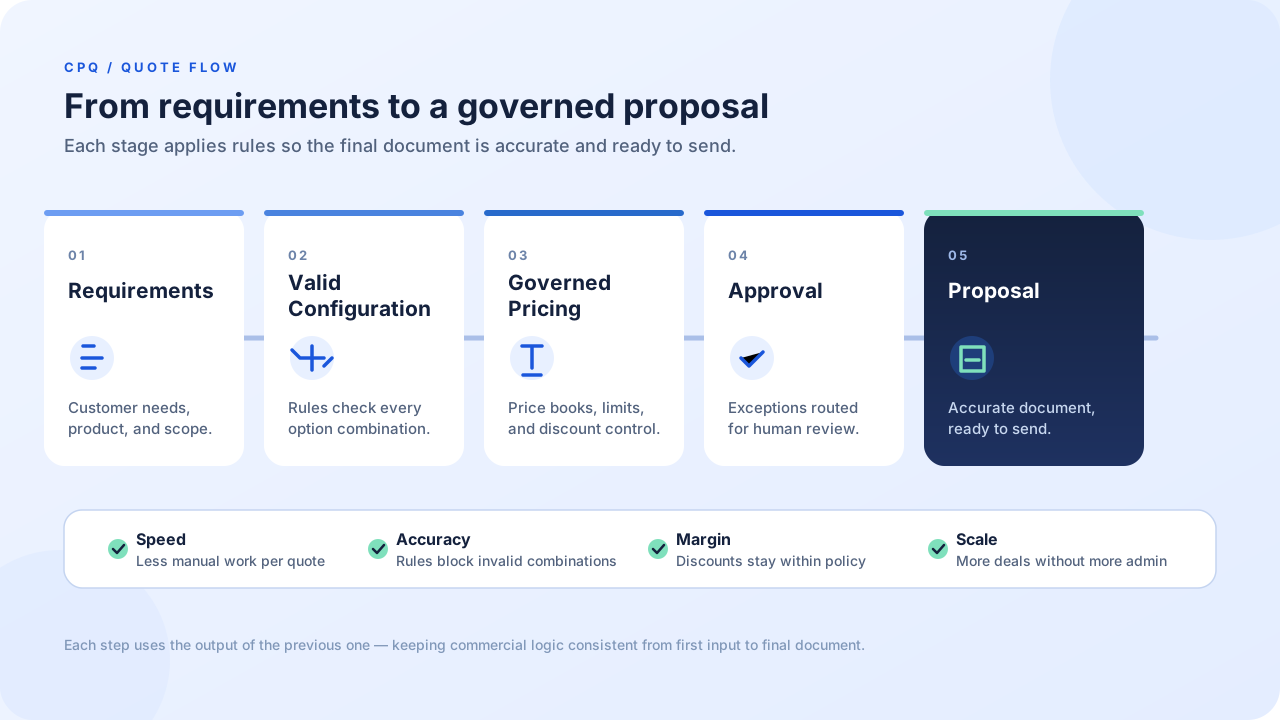
CPQ software compresses those steps into a single guided flow: customer requirements → valid configuration → governed pricing → approval (if needed) → proposal. The seller moves through the chain without switching between systems or waiting for colleagues.
2. More Accurate Quotes and Product Configurations
Two error types appear most often in manual quoting. Configuration errors occur when a seller proposes an incompatible combination of products or components. Pricing errors occur when the wrong price list, discount, or condition is applied.
CPQ software checks every selection against stored rules before the quote reaches the customer. For a large catalog or technically complex products, this validation is difficult to replicate reliably through manual review.
The takeaway: catching errors inside the software is faster and cheaper than correcting them after a sales proposal has been sent.
3. Better Margin Protection
Margin erosion in sales is usually not deliberate — a rep applies a larger discount than intended, or a complex configuration omits a component that carries cost. Both situations are easy to miss when pricing is managed manually.
CPQ can enforce minimum prices, cap discounts at defined thresholds, and route exceptions to an approval step. The result is a consistent commercial signal across every sales channel. Among the tangible benefits for finance teams, this is one of the clearest.
4. More Consistent Pricing and Discount Control
A quote can be mathematically correct and still be inconsistent. Two reps handling similar customers in different regions may apply different discounts or price lists simply because the rules exist only in scattered documents.
CPQ software centralizes price books, discount schedules, and eligibility rules. Commercial policy is defined once and applied uniformly across direct sales teams, partner channels, and regional offices — reducing preventable pricing variation.
5. Less Administrative Work for Sales Teams
Alongside the core quoting task, reps spend time searching for current data, requesting pricing approvals, and moving information between systems. That overhead grows with deal complexity.
CPQ automates much of that coordination. Price lookups, compatibility checks, and routine approval routing happen inside the platform. Sales teams can redirect the recovered time toward customer conversations — one of the most practical day-to-day benefits of automation.
6. Easier Sales Rep Onboarding
A complex catalog is one of the harder things to teach. New sales reps need time to learn which products combine correctly, which prices apply to which customers, and which situations require a manager's sign-off.
CPQ encodes much of that knowledge into the system itself. A guided configuration prompts the rep with valid options and surfaces approval requirements. Using the software, a new hire can prepare accurate quotes without memorizing every rule — onboarding shortens because the platform carries part of the expertise.
7. Better Customer Buying Experience
For the customer, the visible difference is clear: proposals arrive faster, configurations are correct from the start, and pricing is transparent. The situation where a company re-sends a corrected quote after discovering an error becomes less common.
CPQ also makes it practical to tailor the offer — add-ons, service options, or packaging variations — while still applying the company's commercial rules. Personalization and governance coexist when the rules are embedded in the system.
8. More Upsell and Cross-Sell Opportunities
Additional sales opportunities are easier to act on when the system surfaces them at the right moment. CPQ can recommend compatible accessories, service agreements, or extended configurations based on what the customer has already selected.
A rep choosing a piece of equipment may be presented with a compatible maintenance package or upgrade. The recommendation is grounded in compatibility rules rather than habit, so relevant sales opportunities are less likely to be overlooked.
The takeaway: structured upsell logic helps sales reps increase deal value consistently, not sporadically.
9. Better Collaboration Across Sales, Finance, and Operations
A commercial proposal touches more than the sales team. The product group owns configuration validity, finance owns pricing and margins, and operations owns delivery feasibility. Without a shared system, alignment depends on repeated manual handoffs.
CPQ provides a common data layer. Configuration rules, pricing conditions, and approval requirements are defined centrally, so each team's constraints are embedded in the quoting process. Fewer separate negotiations are needed before a sales deal can advance.
10. Greater Scalability and Faster Pricing Changes
A manual process may work at low volume, but adding new products, markets, sales channels, or reps amplifies the fragility. More combinations require more checking, and more people introduce more variation.
CPQ software scales through rules, not headcount. When pricing conditions change — a new promotional period, a revised discount policy, or a supplier cost update — the change is made once and applies immediately to all new quotes. There is no need to distribute files or retrain the entire sales organization.
“The scalability of a governed CPQ system comes from centralizing commercial knowledge. Changing one rule changes the behavior of every quote that follows — without any manual distribution.”
How CPQ Benefits Different Teams
The benefits of a governed quoting system extend beyond the sales department. Each group that contributes to a proposal receives distinct benefits from shared, centrally maintained rules.
| Team | Primary benefit |
|---|---|
| Sales | Faster, more accurate quotes with less time spent on administrative coordination |
| Finance | Pricing and discounts stay within policy; exceptions surface for explicit approval |
| Product management | Configuration rules are enforced automatically, reducing invalid combinations in proposals |
| Operations | Orders carry clean, validated data downstream — fewer corrections before fulfillment |
| Sales management | Consistent commercial behavior across teams and regions; clearer pipeline visibility |
How Quortix Extends the Benefits of Modern CPQ
The operational benefits of CPQ software depend on the system being easy to maintain. If updating pricing rules requires a developer, or if administrators cannot test a change before it affects live quotes, some of those benefits erode over time.
Quortix is a CPQ platform built around a visual administration model. Catalog items, configuration rules, pricing conditions, and commercial constraints are managed in a unified workspace. Business owners can see how rules connect, identify what a proposed change would affect, and verify the outcome before publishing.
External AI agents connect to Quortix over MCP — the Model Context Protocol — and can draft catalog structures or rule updates from a plain-language description. Every AI-generated change goes through a visual diff review before a person approves it. Deterministic controls remain the foundation: the software enforces rules exactly as defined, and human approval is a required step.
The same agent can prepare a quote draft from customer requirements, using the current catalog and active constraints. A rep or administrator reviews the draft, adjusts if needed, and sends. There is no autonomous publishing — every consequential action requires explicit human confirmation.
- Reduced dependency on developers for routine pricing or rule changes — business owners operate the catalog directly.
- Visual diff review before any rule change is applied, so administrators can see exactly what will change before committing.
- Test mode for new pricing conditions, letting sales and pricing teams validate outcomes before going live.
- AI-assisted catalog and rule drafting via external agents over MCP, with mandatory human approval at each step.
- Quote draft generation from customer requirements, respecting the active catalog and all defined constraints.
- Full change history so every rule update, approval, and configuration revision is traceable.
Conclusion
CPQ software delivers advantages that go well beyond document speed. The deeper benefits emerge when a company moves product knowledge, compatibility rules, pricing conditions, and discount controls into a system that applies them consistently — regardless of which seller, region, or channel is involved.
When that foundation is in place, sales teams quote more accurately, margins are easier to protect, onboarding shortens, and the process absorbs more volume without proportionally more administration. The result is a sales operation that is not just faster, but more reliable and easier to manage as the business grows.