
Intuitive visual rules engine
See your logic. Trust your logic.
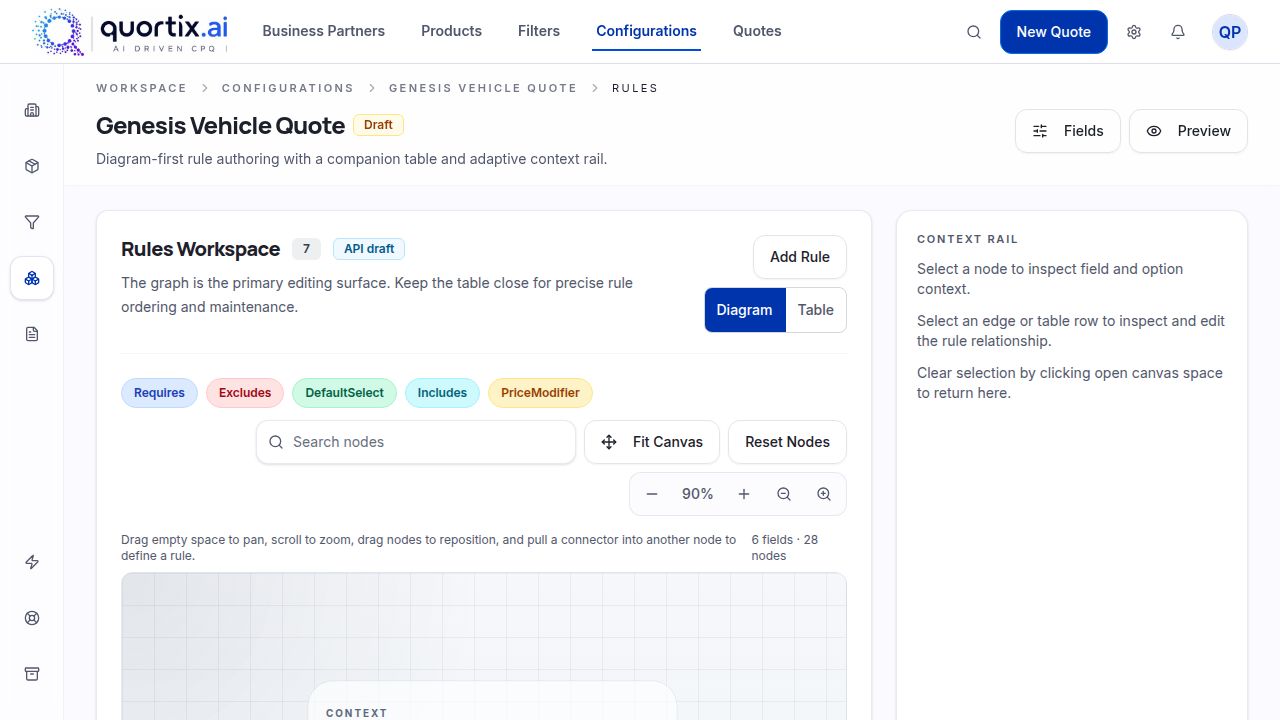
Legacy CPQ tools bury business logic in opaque scripts that nobody dares touch. quortix.ai turns rules into visual flows that anyone on the team can read, edit, and audit. Combined with AI agents that draft changes over MCP, that means business users can confidently evolve the configurator instead of waiting on a consultant.
Why rules transparency is a competitive advantage
When pricing logic lives in a script that only one person can read, every change is a risk — and every change request creates a bottleneck. Business users can't validate what they can't see, which means errors accumulate silently until they show up in a mispriced deal or an invalid order. A visual rules engine eliminates that risk by making the logic legible to the people who own it: product managers, pricing leaders, and sales operations — not just the admins who maintain it.
Building rules on the visual canvas
In quortix.ai, constraints, pricing tiers, eligibility conditions, and bundle rules are built as visual flows on a canvas. Dependencies between rules are shown as edges — you can see at a glance which rules affect each other, which products share a pricing condition, and what fires when a specific option is selected. AI agents can draft new rules from a plain-language description over MCP, placing them on the canvas for you to review and connect. Changes go through the visual diff before they're applied.
- Constraint rules: enforce valid configurations and block incompatible combinations.
- Pricing rules: tiered, attribute-based, and volume-sensitive pricing on the canvas.
- Eligibility rules: control which products, options, and promotions are available to whom.
- Dependency graph: see which rules interact before you ship a change.
Testing rules before they reach a customer
The quortix.ai rules engine ships with a built-in simulator. Load any rule set, specify a configuration scenario, and run it — the simulator shows exactly which rules fired, in what order, and what outputs they produced. That means you can validate a pricing change, a new constraint, or a promotional rule against real examples before approving it. No more discovering a rules conflict in a live quote.
What you get
- Visual canvas for constraints, pricing, and eligibility.
- Live dependency graph so changes never surprise you.
- Built-in simulator to test rules against real configurations.