AI Quote Generator for Faster Sales Quoting
Give sellers a useful first draft, not another blank document. Authorized external AI agents connect through MCP, the Model Context Protocol, to work with your product catalog and pricing rules. Published rules run deterministically. Your team can inspect the draft in Quortix’s visual workspace, check the details, and deliver the quote through its usual customer communication process.
Why AI-Guided Quoting?
A customer’s request rarely arrives as a neat list of products. Turning it into a clear offer takes work.
Too Much Searching
Sellers piece together product choices, quantities, and dependencies before they can begin a quote. Each lookup interrupts the conversation.
Pricing Mistakes
Copied prices and overlooked conditions can leave an offer out of step with current commercial policy, creating avoidable corrections.
Repeated Rework
Missing requirements surface late. Sellers and operations then revisit the same deal instead of moving the customer toward a decision.
How the Process Works
AI interprets the request; CPQ calculates the result. The workflow below separates those responsibilities so a fluent response is not mistaken for a checked commercial offer. If the request changes, the agent can revisit the inputs and simulate again before revising the draft. This helps sellers compare alternatives without treating an earlier calculation as valid for a different configuration.
Customer Requirements
Capture what the customer needs: intended use, quantities, required options, and any limits. Keep uncertainties visible rather than treating incomplete discovery notes as settled facts.
External AI Interprets
An authorized external agent interprets those requirements and inspects permitted catalog data through MCP. It proposes a configuration, with assumptions that the seller can check.
Simulates Published Rules
The agent calls simulation tools to evaluate catalog choices against published configuration and pricing rules. Quortix calculates the outcome; the model does not substitute its own arithmetic.
Creates Draft Quote
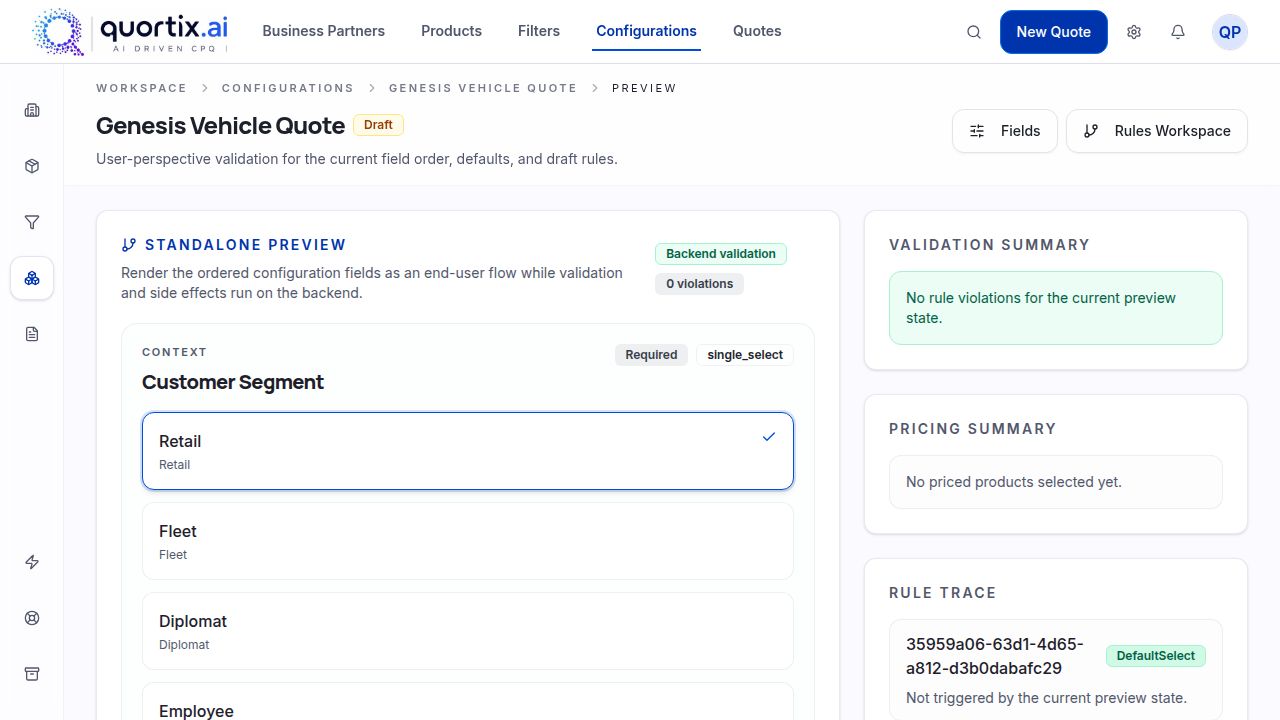
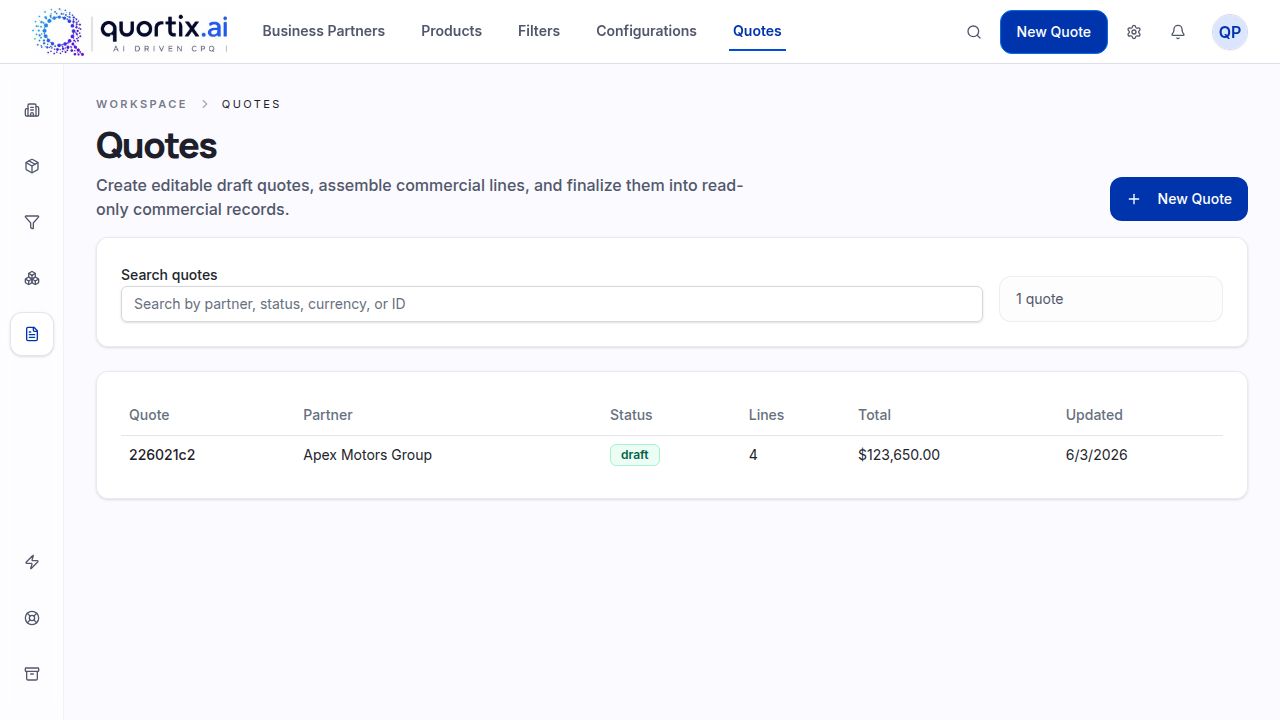
Within its permissions, the agent creates or updates a structured quote draft. The visual workspace makes products, quantities, and pricing available for inspection and further edits.
Human Review & Delivery
We recommend human review of the configuration, prices, and assumptions. The seller then delivers the quote through the team’s normal process; this is not an automatic sending feature.
Intelligent Quoting Capabilities
Requirement Analysis
An external agent connects buyer language to catalog options. It helps organize the request into inputs that can be checked, while leaving room for clarification.
Quote Draft Creation
Permitted draft operations let an agent prepare or revise quote data. Sellers start with structured line items rather than copying everything into a new document.
Catalog & Pricing Rules Validation
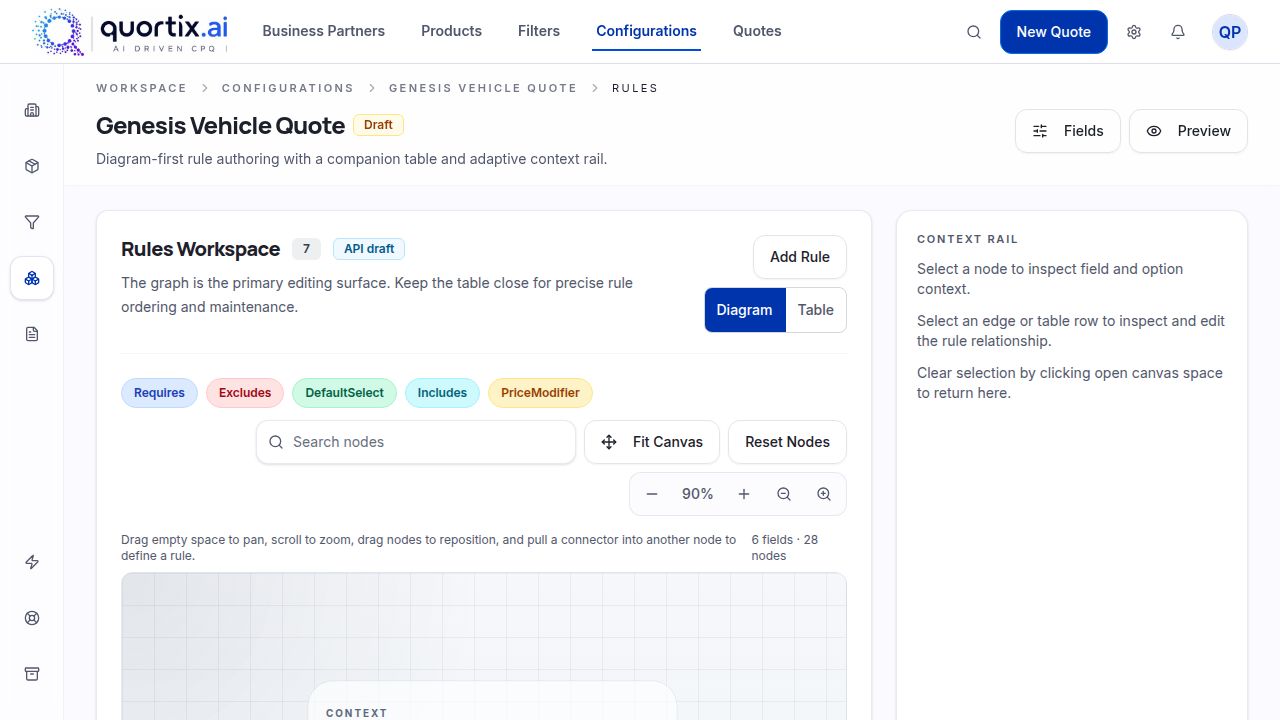
Simulation evaluates the proposed choices using published rules. Its result gives the agent and seller a concrete basis for checking configuration and pricing.
Bundle & Promotion Recommendations
An agent can explore bundles, promotions, and possible upgrades represented in your catalog and rules. Recommendations depend on modeled conditions, not invented offers.
Human Review & Control
Inspect and edit the draft in the visual workspace. Decide whether it fits the customer’s needs; Quortix does not impose a mandatory review or approval workflow.
Accurate Quotes Powered by CPQ Rules
A well-written proposal can still contain the wrong products or prices. Quortix keeps commercial calculation separate from AI interpretation, using published CPQ logic rather than asking a model to invent the offer.
Your product catalog defines the available items. Configuration rules express dependencies and combinations. Pricing rules calculate amounts, while eligibility rules and promotions define when an offer applies. These controls are only as complete and current as the policies your team models and publishes.
Authorized agents can inspect data, simulate outcomes, and update permitted catalog, rule, and draft objects. Access depends on granted permissions. Sales operations owns the commercial setup; sellers check that the simulated result also matches the buyer’s actual requirements. Deterministic calculation does not make an AI interpretation infallible. For example, a promotion may depend on a particular bundle or quantity. Model that condition in the rules and test the outcome, rather than relying on a persuasive recommendation to establish eligibility.
Benefits for Sales Teams
Faster Quote Creation
Shorten the path from discovery to a usable first offer, giving sellers more time to address the details that matter.
Reduced Manual Work
Spend less effort transferring deal information between working notes and quote drafts, leaving more attention for the customer.
Fewer Pricing Errors
Reduce avoidable corrections caused by copied prices or missed conditions, with published rules providing a consistent calculation basis.
More Consistent Sales Process
Give teams a shared commercial foundation instead of relying on each seller’s memory of the latest product and pricing changes.
Faster Response to Customers
Keep conversations moving when requirements change, with less backtracking before the next useful answer. Results depend on your setup and review practices.
Works Across Sales Workflows
Direct Sales
Representatives can use authorized agents to prepare drafts from discovery notes, then inspect them in the workspace. Sales operations maintains the catalog and published policies, keeping the commercial foundation aligned as products and offers change.
Channel Partners
Where partner access is configured, agents can work only with the data and operations their authorization permits. Scope access to the relevant quoting tasks rather than treating channel participation as permission to change catalog or rule definitions.
Self-Service Design
For a customer-facing workflow, plan which choices, data, and actions to expose, with permissions appropriate to that audience. This is a deployment scenario to discuss, not a ready-made customer portal or live self-service product on this site.
Compare Quoting Approaches
| Task | Traditional Manual Quoting | Document AI | Quortix with External AI |
|---|---|---|---|
| Interpret requirements | Seller translates notes | Drafts explanatory text | Agent proposes catalog choices |
| Check products and prices | Seller checks sources | Depends on supplied context | Simulates published CPQ rules |
| Prepare the offer | Manual entry | Generates document content | Creates permitted structured drafts |
| Review and delivery | Team’s established process | Team checks generated content | Recommended human review; team handles delivery |
Related Platform Features
Explore how administration, visual rule design, and modeled offers support the same quoting foundation. Each has a different role in keeping your setup usable and current.
Frequently Asked Questions
What is an AI quote generator?
It helps turn customer requirements into a quote draft. In Quortix, an authorized external AI agent uses MCP tools to work with catalog data, simulate published rules, and prepare structured drafts rather than just write proposal text.
How does intelligent quote generation work?
An external agent interprets the request, inspects permitted data, and simulates a configuration against published rules. It can then create or update a draft. We recommend checking the result in the visual workspace before delivering it to a customer.
Can AI generate quotes based on product and pricing rules?
Yes. Published CPQ rules calculate the configuration and pricing outcome deterministically. The agent can use that result when preparing a draft, but its interpretation of the customer’s needs still deserves human review.
How is AI quoting different from proposal generation?
Proposal generation usually focuses on wording and presentation. Quortix adds structured products, configuration logic, and rule-based pricing. Review is a recommended operating practice, not an enforced approval gate; customer delivery remains part of your team’s process.
Bring a real quoting challenge.
See how external agents, published rules, and the visual workspace fit together. We’ll discuss your catalog, permissions, and review practices in a demo built around your needs.
Get a Demo