
CPQ: What Configure, Price, Quote Means and How It Works
A complete guide to CPQ: how the configure, price, quote process works, what CPQ software does, who needs it, and how it differs from CRM and ERP.
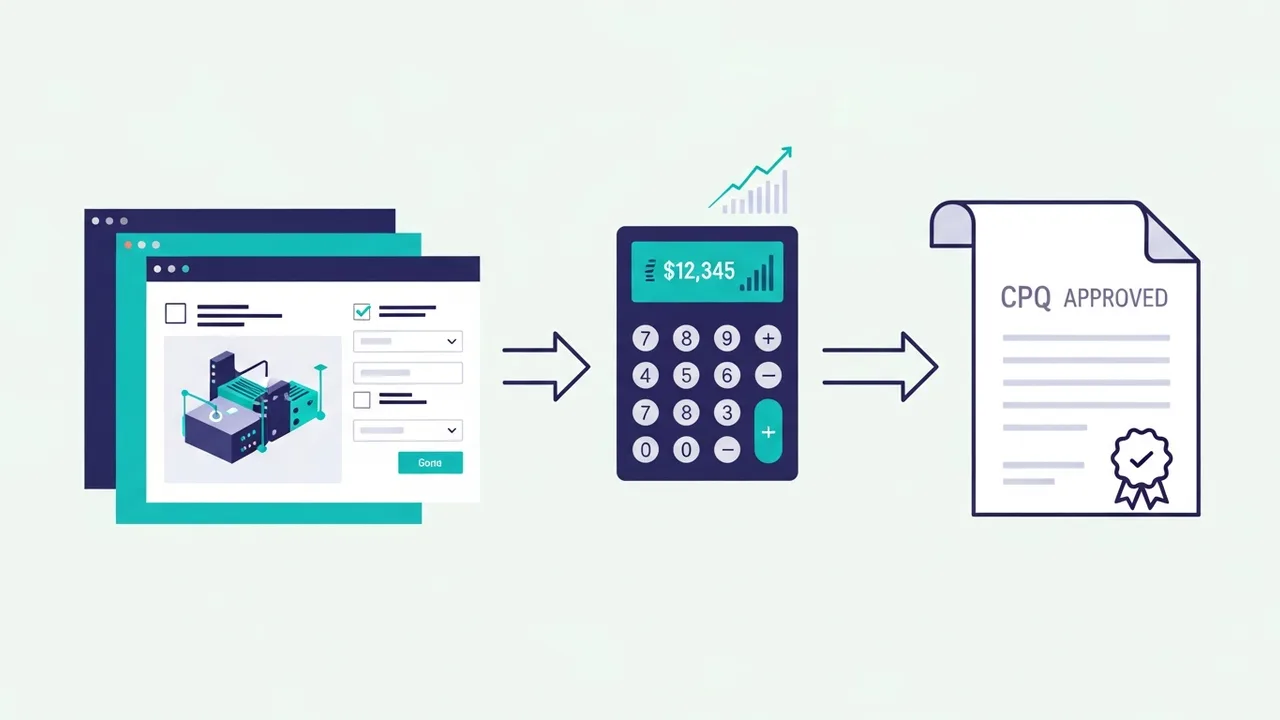
If you have searched for the CPQ meaning, here is the short answer: CPQ stands for Configure, Price, Quote. The term describes both a business process and a category of software. As a process, it covers how a sales team selects the right product configuration for a customer, calculates the correct price, and produces a formal quote. As software, it automates that process from the first customer requirement to the approved document.
The reason CPQ software exists is simple. When a company sells configurable products with many options, price lists, and discount rules, preparing quotes by hand becomes slow and error-prone. Sales reps copy numbers between spreadsheets, apply outdated discounts, and quote combinations that operations cannot deliver.
This article explains how CPQ works step by step, what features CPQ systems typically include, who benefits from them, and how CPQ differs from CRM and ERP software. By the end, you should be able to judge whether your own quoting process needs it.
What Is CPQ?
CPQ is the process of turning a customer's requirements into a complete, correctly priced commercial proposal. The three letters describe its three stages. Configure: select the products, options, and quantities that fit the customer and exclude combinations that cannot work together. Price: apply the right price list, discounts, and margin rules. Quote: assemble the result into a document the customer can approve.
Every company that sells anything more complex than a single fixed-price item runs this process, whether it has software for it or not. In many organizations it lives in spreadsheets, email threads, and the memory of a few experienced sales reps.
CPQ software is the category of tools that automates the process. It stores the product catalog, the configuration rules, and the pricing logic in one system, so that any rep can produce a valid quote without asking engineering to check the configuration or finance to confirm the price.
So when people ask what CPQ means, the honest answer is both: it is the quoting process itself, and it is the software that makes the process fast, consistent, and auditable.
A useful way to keep the two senses apart: the process exists in every company that sells configurable products, while the software determines how well the process runs. Companies without dedicated software still do CPQ — their spreadsheets simply act as the software, without the rules, guardrails, or audit trail.
How Does CPQ Work?
CPQ software accompanies the sales rep from the moment a customer expresses a need to the moment an approved quote is sent. The flow is sequential, and each stage builds on the previous one.
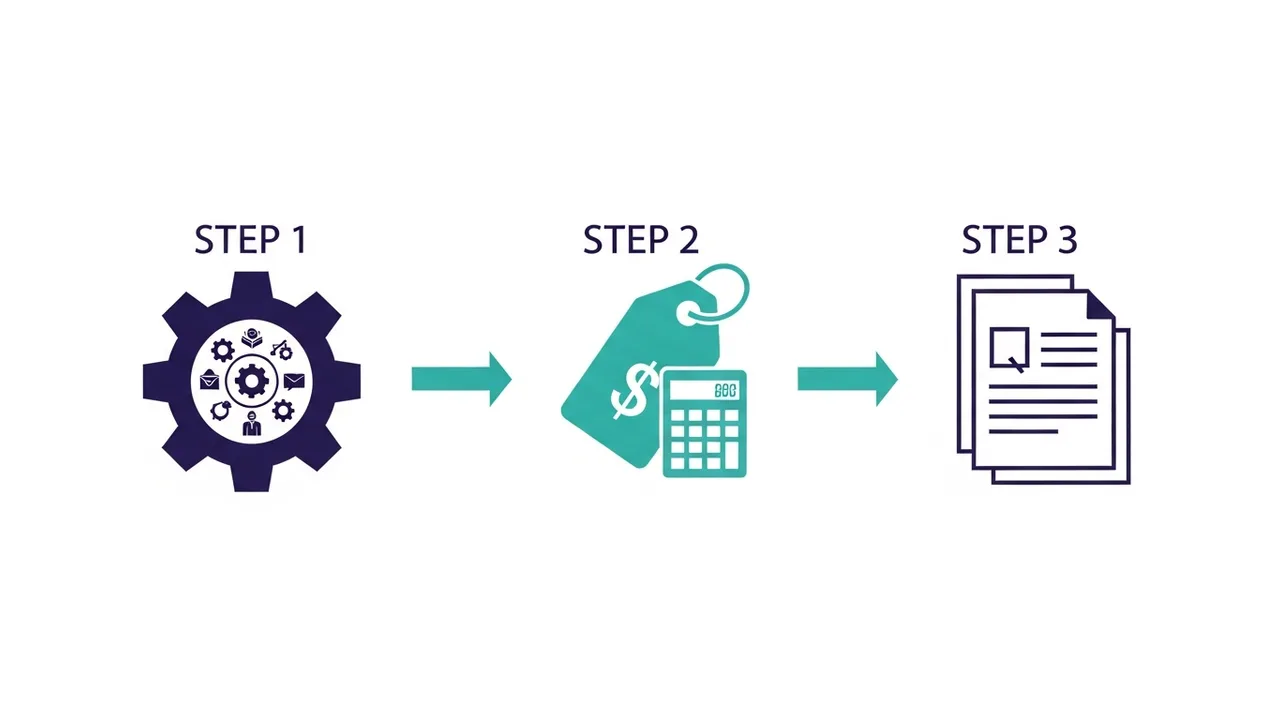
Step 1 — capture the requirement. The process starts with what the customer actually needs: capacity, region, industry constraints, budget range. In modern CPQ systems this can be a short guided questionnaire, an imported opportunity from the CRM, or a plain-language description.
Step 2 — configure the product. The system translates the requirement into a concrete product configuration. Rules stored in the software decide which options are compatible, which are mandatory, and which are excluded. If a rep selects an option that conflicts with another, the system blocks it immediately instead of letting the error travel downstream.
Step 3 — calculate the price. The software applies the correct price list for the customer segment, region, and channel, then layers on volume discounts, promotions, and contract terms. The rep sees the final number and the margin impact without touching a spreadsheet.
Step 4 — route approvals. If a discount exceeds the rep's authority, the quote goes to the right approver automatically. Nothing depends on someone remembering to forward an email.
Step 5 — generate and send the quote. The system assembles a branded document with the configuration, terms, and validity period, and records exactly what was offered. When the customer accepts, the same structured data flows into order processing without retyping.
The whole cycle that used to take days of back-and-forth between sales, engineering, and finance compresses into minutes — because the knowledge those teams held is encoded in the system.
Throughout the flow, the sales rep stays in one environment. The system pulls customer data from the CRM, applies rules maintained by sales operations, and pushes the accepted quote onward — the rep sells, and the software handles the bookkeeping around the sale.
Key Features of CPQ Software
The exact feature set varies by platform, but most CPQ systems share the same core capabilities. The differences are usually in depth and usability rather than in the list itself.
The foundation is the product catalog and configuration engine. It holds products, options, attributes, and the rules that connect them: compatibility constraints, required components, quantity limits. A good engine makes invalid configurations impossible to build, which is the single biggest source of quoting errors it removes.
On top of that sits the pricing engine. It manages price lists by segment, currency, and channel, and applies discounting logic: volume tiers, bundles, promotions, contract-specific terms. Centralizing this logic is what lets a company change a price once and have every new quote reflect it.
Around the core, CPQ software adds workflow and document features: approval chains for discounts and non-standard terms, quote document generation with templates and branding, quote versioning, and integrations that sync data with CRM, ERP, and billing systems. Guided selling — needs-based questions that lead a rep to the right product — is increasingly standard as well.
Most platforms also include reporting and analytics. Because every quote is created in the software, sales leaders can see win rates by product, discount patterns by rep, and where deals stall in approvals. That visibility is impossible when quotes live in scattered files, and it is one of the quieter reasons companies adopt CPQ systems.
AI plays a growing role in modern CPQ systems. It can recommend products and bundles based on similar deals, find the right catalog items from a plain-language request, and analyze quotes to flag unusual discounts or at-risk margins. It is worth keeping the layers straight, though: the core configuration and pricing rules are deterministic and work without AI. AI accelerates the people using the system; the rules keep every quote correct.
Benefits of CPQ Software
The value of CPQ software is not the PDF at the end. It is the speed, consistency, and control it brings to the whole quoting process. The benefits fall into three groups.
These outcomes compound. A faster quote shortens the sales cycle; an accurate quote prevents rework; controlled pricing protects margin on every deal. None of them requires reps to change how they sell — the software changes what happens around the selling.
Faster and More Accurate Quotes
The most immediate effect is time. Quotes that took days of manual assembly go out in minutes, because the rep no longer hunts for the current price list or waits for engineering to validate a configuration. Faster responses matter commercially: in competitive deals, the first credible quote often sets the reference point.
Accuracy improves just as much. CPQ systems eliminate the classic manual quoting errors:
- Outdated prices copied from an old spreadsheet or a stale email thread.
- Incompatible products quoted together because nobody caught the conflict.
- Wrong discounts — expired promotions, or rates the rep was not authorized to give.
- Missing items, such as required accessories, licenses, or installation services.
- Mismatches between the quote and the final order, discovered only at delivery.
Each of these errors costs more than the correction itself. A wrong quote erodes customer trust, delays the deal, and often forces the company to honor a price it never intended to offer.
Better Pricing Control
With centralized rules, pricing stops being a matter of individual judgment. Discount limits, margin floors, and approval thresholds are enforced by the system on every quote — not published in a policy document nobody reads mid-deal.
Reps no longer search for the right price across different tables or ask finance to confirm every exception. The system already knows which price applies to this customer, in this region, at this volume. Finance gets fewer escalations; sales gets faster answers; leadership gets margins that hold.
Centralized control also makes pricing changes safe. When finance updates a list or launches a promotion, the change takes effect in the software immediately, for every rep, in every region. There is no window where half the sales team quotes old numbers because they have not opened the newest spreadsheet.
“Margin leakage rarely comes from one bad deal. It comes from hundreds of small, invisible discount decisions made under time pressure. CPQ makes those decisions visible and governed.”
Improved Sales and Customer Experience
For the sales team, CPQ software removes administrative drag. Less time assembling documents means more time with customers. New hires ramp faster, because the system encodes the catalog knowledge that veterans carry in their heads.
Customers feel the difference too:
- Sales reps spend less time on administrative tasks and more on the actual conversation.
- New employees learn the catalog through the system instead of months of shadowing.
- Customers receive a clear, professional proposal quickly — while their interest is high.
- Fewer corrections and re-quotes, so deals keep their momentum.
- The system can recommend relevant add-ons and services the rep might not think of.
Who Needs CPQ Software?
The need for CPQ is driven by complexity, not company size. A ten-person manufacturer with configurable equipment may need it urgently, while a large company selling one flat-rate service may not need it at all.
The signs that quoting complexity has outgrown manual tools are consistent:
- Products have options or dependencies that require expert knowledge to combine correctly.
- Pricing varies by customer segment, volume, region, or contract — and changes often.
- Quotes routinely wait on approvals, engineering checks, or finance confirmations.
- Errors in past quotes have cost real money or damaged customer relationships.
- Only a few experienced people can produce a correct quote unaided.
Short examples make it concrete. A SaaS vendor sells plans with user tiers, add-on modules, and annual-versus-monthly terms; CPQ keeps every permutation priced correctly. An industrial equipment maker sells machines with engineered options, where the wrong combination means a wrong installation; CPQ blocks invalid builds at quote time. A medical device distributor manages contract pricing that differs by hospital group; CPQ applies the right contract automatically.
If two or more of the signs above describe your sales process, the complexity is already costing you — the only question is whether it is visible in your metrics yet.
There is also a timing dimension. Companies usually adopt CPQ software after a visible failure — a mispriced contract, or a quarter of quotes stuck in approvals. Adopting earlier is cheaper: quoting knowledge gets encoded into the system while the people who hold it are still available.
CPQ vs. CRM and ERP
CPQ, CRM, and ERP are often mentioned together, and they do work in one chain — but they answer different questions. CRM software manages the relationship: who the customer is, what stage the deal is at, what was promised. ERP systems manage execution: inventory, production, fulfillment, invoicing, accounting.
CPQ sits between them. It takes the opportunity from the CRM, turns it into a valid configuration with a correct price, and hands the accepted quote to the ERP as a clean order. It does not replace either system; it connects the selling motion to the operational one.
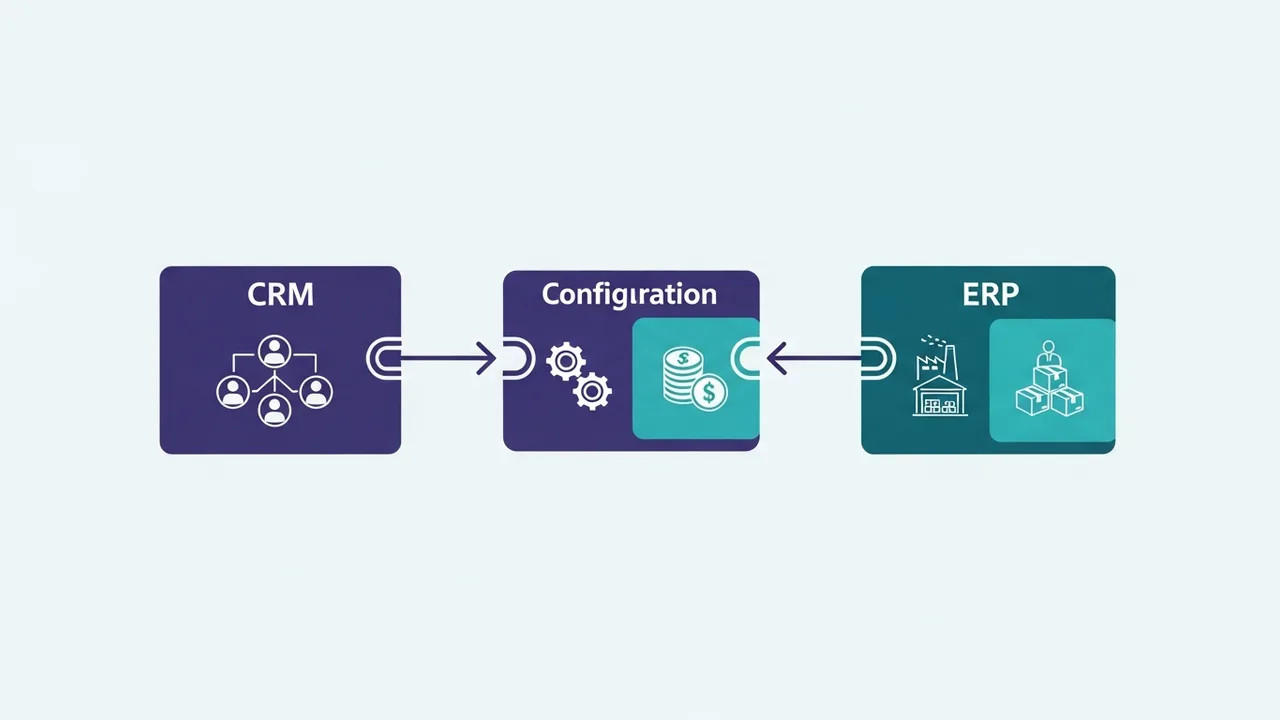
This chain is part of a broader process called quote-to-cash: everything from the first quote through contract, order, invoice, and payment. CPQ covers the front of that process; ERP and billing systems cover the back.
In practice, most companies integrate all three pieces of software: the CRM triggers quoting, CPQ produces the priced proposal, and the ERP fulfills the order. When the systems are connected properly, data is entered once and flows along the chain — which is exactly what manual quoting fails to guarantee.
| CRM | CPQ | ERP | |
|---|---|---|---|
| Primary role | Manage customer relationships and the sales pipeline | Configure products, calculate pricing, generate quotes | Run operations: inventory, production, finance |
| Core question | Who is the customer and where is the deal? | What exactly are we offering, and at what price? | Can we deliver it, and how do we account for it? |
| Typical users | Sales reps, marketing, customer success | Sales reps, sales operations, pricing teams | Operations, supply chain, finance |
| Key data | Contacts, accounts, opportunities, activities | Catalog, configuration rules, price lists, quotes | Orders, stock, invoices, ledgers |
How to Choose CPQ Software
The right way to choose a CPQ platform is to start from your sales process, not from feature checklists. Map how a quote is actually produced today: where requirements come from, who touches the quote, where it stalls, and where errors appear. The platform's job is to fix that specific process.
With the process mapped, evaluate candidates against a few criteria:
- Configuration and pricing model support. Can the system express your real product structures and pricing logic — bundles, tiers, regional lists — without custom code?
- Ease of use for sales reps. If quoting in the tool is slower than the old spreadsheet, reps will go around it, and the investment is lost.
- Ease of changing rules. Prices and catalogs change constantly. Can your own team update rules, or does every change require a consultant or a developer?
- Integration with CRM, ERP, and billing. The quote must flow into the systems around it; retyping data between tools reintroduces the errors CPQ exists to remove.
- Time to value. Some platforms take months of implementation before the first quote; modern software should produce value in days or weeks.
Weight the criteria by where your process hurts most. A company drowning in pricing exceptions should prioritize rule governance; one losing deals to slow responses should prioritize speed and usability for the sales team.
Finally, plan the rollout as a process change, not a software installation. Involve the sales reps who will use the tool daily, migrate one product family first, and measure quote turnaround before and after. CPQ systems succeed when the sales organization trusts them — and trust comes from an early, visible win.
CPQ FAQs
What Does CPQ Stand for in Sales?
In sales, CPQ stands for Configure, Price, Quote. It refers to the process — and the software — a sales team uses to build a valid product configuration, apply correct pricing, and produce an accurate commercial proposal quickly.
Is CPQ Part of CRM?
Not inherently. CPQ can be embedded in a CRM suite or run as standalone software integrated with one, but it performs a distinct task: the CRM tracks the relationship, while CPQ produces the configured, priced quote.
What Is an Example of CPQ?
A SaaS vendor quoting a plan with user tiers and add-on modules, or an equipment maker quoting a machine with engineered options — in both cases the software validates the configuration and calculates the price automatically.
Do Small Businesses Need CPQ?
It depends on complexity, not headcount. A small business with configurable products, variable pricing, and frequent approvals gains as much as a large one. A small company selling simple fixed-price items usually does not need it.
What Is the Difference Between CPQ and Quote-to-Cash?
CPQ covers configuration, pricing, and the quote itself. Quote-to-cash is the wider process that also includes contract signing, order management, invoicing, and payment collection — CPQ is its first stage, feeding the systems downstream.
Conclusion
CPQ began as an acronym, but for most companies it is a practical question: can any rep on the sales team produce a correct, approved quote quickly, without depending on tribal knowledge and manual checks?
If your quoting still runs on spreadsheets, manual price lookups, and constant corrections, that is the signal. The complexity will not shrink — catalogs grow, pricing multiplies, and every manual step compounds the risk. Evaluating CPQ software against your real sales process is the logical next step, and the sooner the process is systematized, the less it costs to fix.
Related reading
- Best CPQ Software: 9 Platforms Compared — compare platforms once you understand the configure, price, quote process.
- The end of the CPQ implementation project — explore what it takes to move from evaluation to a working CPQ.
- Explore the quortix.ai platform — see how configuration, pricing, and quoting work together.