
CPQ vs. CRM: What’s the Difference and When Do You Need Both?
Compare CRM and CPQ responsibilities, follow an opportunity through quoting, and learn when commercial complexity calls for an additional quoting layer.

CRM and CPQ solve different problems in the sales process. Customer relationship management records customers, conversations, and opportunities. Configure, price, quote checks a proposed purchase against product and pricing rules, then prepares the offer. A complete customer record does not, by itself, make a selected product combination valid.
CPQ usually complements CRM. Follow one recent quote: where did the seller check compatibility, calculate the price, and obtain an exception decision? That walkthrough is the best starting point. It reveals gaps in customer information, quoting rules, or policy.
What Is the Difference Between CPQ and CRM?
CRM explains who the customer is and where the deal stands; CPQ explains what is being sold and under what commercial conditions. The account record identifies a distributor; a quoting rule selects their price list. An integrated platform may handle both tasks, but each needs an owner.
Consider a hypothetical pump sale. The seller has the correct contact and closing date, but the chosen monitoring accessory needs a control unit absent from the quote. Recording more calls will not catch that omission. A product rule must identify the dependency, or a specialist must check it before the offer goes out.
The reverse matters too: a valid pump quote says nothing about whether procurement has budget or who signs the order. The best handoff keeps the buyer's next step beside the offer's status. CRM software records that relationship context; CPQ software checks the offer against the rules the business has supplied.
Keep quote readiness separate from buying intent. An engineer may still be checking the site requirements while procurement has already agreed a purchase date. Or the quote may be ready while funding remains uncertain. Record the technical task and the buyer milestone separately; neither status is a reliable substitute for the other.
What Does CRM Manage in the Sales Process?
CRM typically brings accounts, contacts, communications, activities, opportunities, pipeline stages, and sales history into a shared record. A seller can see previous conversations, record a next action, and explain how a potential purchase fits an existing customer relationship.
In a forecast review, ask what the buyer has done since the last meeting. Sending a proposal is a seller activity; receiving confirmation of budget is a buyer milestone. The best stage definitions make that distinction explicit, with evidence the team can check rather than a hopeful interpretation of a sent document.
For manufacturers, the account record may also identify a distributor, purchasing organization, or installation site. Those relationships help a seller understand the transaction, but they do not establish whether the requested equipment is technically compatible. Customer identity and product validity require different controls even when displayed together.
A CRM platform may already include quote functions. Test them before assuming another purchase is necessary. Ask a seller to reproduce a recent offer using the proposed edition, including its discount and optional lines. The best evidence is the resulting calculation and document, not a feature label in the sales demonstration.
What Does CPQ Manage in the Sales Process?
CPQ evaluates a proposed offer: selected products, required accessories, quantities, price calculations, discount eligibility, and terms. Some systems also route exceptions for approval and generate documents. These checks work only when the business has defined the rules and supplied the required inputs. An unmodeled restriction remains a gap, not an automatic safeguard.
For manufacturers selling configurable equipment, selection might depend on dimensions, power supply, operating conditions, and compatible accessories. A valid configuration is not necessarily an engineering release or a production-ready bill of materials. Define which technical checks the quoting layer owns and which still require engineering review.
For a hypothetical SaaS offer, a reporting module might require the enterprise tier, with annual pricing calculated per seat. That is an eligibility rule followed by a calculation, not a mechanical compatibility check. The best test uses the seller's actual inputs: tier, module, seat count, start date, and contract duration.
CPQ software is most useful when selecting a few price-list lines cannot reliably produce an offer. Published rules should have identifiable owners and testable outcomes. Approval requirements remain company policy; whether a particular platform enforces them, records exceptions, or only calculates a draft must be verified independently.
Separate eligibility from arithmetic. In a hypothetical policy, a partner-only bundle is unavailable to direct buyers even if its price is easy to calculate. A 10% discount might be allowed on equipment but not freight. Test the excluded lines and channels as well as the ordinary quote; a correct total can conceal a forbidden choice.
CPQ vs. CRM: Side-by-Side Comparison
Compare responsibilities in the revenue process, not isolated feature names. Modern software packages can overlap, and a CRM ecosystem may include a specialized quoting layer. The following table describes typical primary roles; it does not claim that either category is technically incapable of supporting an adjacent function.
| Criterion | CRM | CPQ | Typical Owner / User |
|---|---|---|---|
| Primary purpose | Coordinate relationships and deal progress | Construct a valid commercial offer | Sales leadership / sales operations |
| Customer and account data | Maintain relationship context and contacts | Use customer context in offer rules | Account team / CRM administrator |
| Opportunity management | Track stage, activities, and expected close | Associate proposals with the opportunity | Sales representative / manager |
| Product configuration | Record product interest or selected lines | Evaluate permitted options and dependencies | Product specialist / engineering |
| Pricing rules | Store or display relevant price information | Apply defined commercial calculations | Pricing team / finance |
| Discounts and approvals | Provide deal context and visibility | Evaluate exceptions and route required review | Sales manager / finance |
| Quote generation | May support straightforward proposals | Generate offers from evaluated configurations | Sales representative / sales operations |
| Quote revisions | Track relationship and opportunity changes | Maintain revised offer content and versions | Sales representative / commercial operations |
| Pipeline forecasting | Aggregate opportunity expectations | Supply quote values and commercial status | Sales leadership / RevOps |
| Data passed to downstream systems | Provide customer and opportunity identifiers | Provide accepted lines, prices, and terms | RevOps / order operations / finance |
Read the table as a starting allocation of work, not a purchasing checklist. A CRM vendor may sell CPQ within its ecosystem, with a separate license and maintenance requirements. The best comparison asks who will update each rule, which edition supports it, and what happens when an offer falls outside the modeled cases.
Where Does CRM Stop and CPQ Begin?
There is no fixed technical stopping point. A CRM may adequately handle standard products, simple quantities, and predictable discounts. The practical boundary appears when the seller needs conditional dependencies, customer-specific price logic, bundle restrictions, or successive approvals that the current setup cannot manage consistently.
Look at where decisions actually happen. If a spreadsheet calculates the price, an email confirms compatibility, and a chat message authorizes an exception, the CRM record may only contain the final number. The organization has a quoting process, but its logic is scattered and difficult to reconstruct.
For manufacturers, inspect the assumptions behind the selected equipment. If a buyer changes the site voltage after the first proposal, an unchanged opportunity stage tells you little about compatibility. The best place for that check is where the revised configuration is evaluated, with unresolved site or engineering questions returned to the responsible specialist.
Adding CPQ is not automatically the answer to poor data hygiene. First distinguish missing rules from missing information and inconsistent working habits. If the underlying price policy is disputed, new software will not settle it. Agree on the policy before asking a platform to execute it.
Ask two sellers to calculate the same recent exception independently. If they use different discount bases, clarify the policy. If one lacks the customer's agreement number, fix the input. If both calculate correctly but disagree on who may authorize the result, settle decision ownership. Those are three different jobs, not one connector problem.
“The relationship record explains the deal; the quoting rules explain the promise.”
How Do CPQ and CRM Work Together?
CRM supplies account, contact, and opportunity context to CPQ. Relevant fields might include transaction currency, selling entity, channel, and an existing agreement reference. CPQ uses the authorized context to evaluate a configuration and offer, then returns agreed information such as quote status, selected products, value, and version.
Write down the trigger for each transfer. Opening a draft may copy the currency and account ID; marking a proposal as current may return its value. The best design also specifies what does not transfer: changing an account's default currency, for example, should not quietly recalculate an offer already under negotiation.
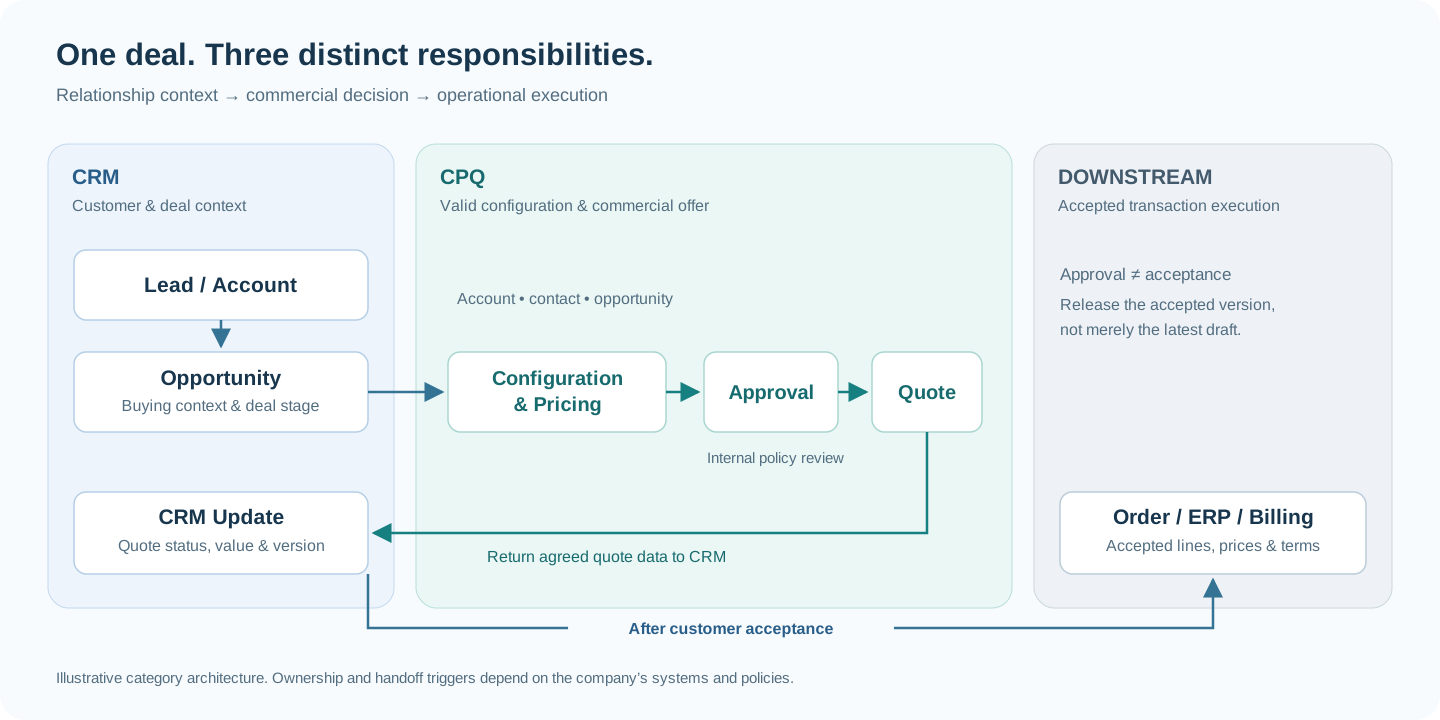
The diagram separates internal approval from customer acceptance. An approved proposal may still be negotiated or rejected. Sending information to order management, ERP, or billing should follow the company's acceptance policy, not merely the generation of a PDF. Preserve a clear reference to the version the customer accepted.
At the platform boundary, carry identifiers rather than relying on names. A revised proposal should retain its opportunity reference and identify its own quote version. When the customer accepts, order operations needs that version's identifier. Two files called 'final quote' are not enough to tell which configuration and price the buyer agreed to.
For a hypothetical opportunity with a $20,000 standard option and a $26,000 upgraded option, the forecast is not automatically $46,000. These are alternatives, not two orders. Designate one proposal as the forecast basis, retain the other for comparison, and change the selection when the buyer indicates which option they intend to purchase.
Practical Example: From Opportunity to Approved Quote
Hypothetical example: a manufacturer quotes an industrial pumping package for an existing site. CRM records the purchasing contact, installation address, target decision date, and opportunity stage. The buyer requests a pump, motor, control unit, and optional monitoring equipment, specifying a 400-volt supply. The figures and policies below are illustrative, not customer results.
The seller opens a draft against the opportunity and enters the site supply. A modeled rule rejects a 230-volt motor for this package and identifies the required control unit. For manufacturers, the useful test is specific: does the quote detect the mismatch, explain the missing component, and prevent that invalid combination where configured?
Assume the eligible equipment subtotal is $20,000 and freight is $500. A requested 12% equipment discount subtracts $2,400, leaving an $18,100 total before tax. Under this hypothetical company's policy, discounts above 10% need finance review. The reviewer checks the eligible lines and rationale; freight is not discounted. Routing depends on the selected system.
After the required internal decision, the seller sends version 1 and returns its status and $18,100 value to CRM. If the buyer changes the motor requirement, the best response is version 2 with compatibility and pricing checked again. The seller should not patch the PDF while leaving the evaluated configuration unchanged.
Once the buyer accepts version 2, the handoff sends that version's lines, prices, currency, and terms to order management, ERP, or billing. Order operations checks receipt and identifies missing production inputs. This is a category workflow: the selected software and integration must support each step; the example is not a product promise.
Include the 400-volt requirement in the accepted record, not just in the seller's notes. If order operations later receives a conflicting site specification, stop and resolve it with the commercial and technical owners. Substituting a motor without revisiting the offer may change both compatibility and cost, even if the order total stays the same.
When Is CRM Alone Enough?
CRM may be sufficient when the catalog is small, products are standardized, prices are straightforward, and exceptions are rare. A seller can prepare the required quote without external arithmetic or a chain of specialist decisions. Adding another application in that situation may create more administration than commercial value.
The best test is a replay of an ordinary sale. Give a second seller the quantities, customer agreement, and price-list date, then ask them to reproduce the offer without the original seller's spreadsheet. Compare line amounts and terms, and locate the accepted version. If that works, the current setup may be sufficient.
Adequate does not mean unattended. Keep product and price records current, assign an owner to the quote template, and establish a clear exception route. Revisit the decision when new channels, product dependencies, or contract policies arrive. A process that works for today's catalog may need additional controls after the selling model changes.
Company size does not answer this question. Small manufacturers may sell equipment with dozens of dependencies; a larger distributor may sell fixed items at published prices. The best reason to add a quoting platform is a repeatable decision the existing process cannot handle, not the number of sellers or the company's growth target.
When Does a Business Need CPQ in Addition to CRM?
Look for repeated decisions that sellers cannot resolve in the current quote record: choosing among price lists, checking bundle dependencies, applying quantity tiers, or identifying exceptions for finance. The best evidence is in recent offers. Note which questions delayed them, who answered, and whether another seller could reach the same answer from recorded inputs.
- External calculations: Sellers rely on spreadsheets to calculate customer-facing quotes.
- Inconsistent pricing: Different representatives interpret the same commercial policy differently.
- Unclear revisions: Teams cannot reliably identify the current or accepted quote version.
- Disconnected approvals: Exceptions are authorized outside the process that creates the offer.
- Invalid combinations: Incompatible products can reach a customer-facing proposal without a check.
- Repeated entry: Accepted lines and terms must be typed again into downstream systems.
Choose a pilot around one recurring problem, such as a product family with frequent accessory omissions. Include an ordinary order, an invalid combination, a pricing exception, and a missing input. The best pilot shows the expected result for each case and names who corrects the rules when the actual result differs.
Manufacturers searching for the best CPQ platform for B2B manufacturers can use those pilot cases as a demonstration script. Ask vendors to show the rejected combination and missing-input behavior, not just the successful quote. A platform that needs custom code for routine catalog changes has a different maintenance cost from one your designated owner can update.
Then ask the future rule owner to change a price and retire an accessory in the proposed setup. The best fit lets that person explain the steps, tests, and required support. Software that only the implementation specialist can maintain needs an ongoing staffing plan; include that work in the buying decision.
What Should RevOps Consider When Integrating CPQ With CRM?
Create an ownership sheet before selecting a connector. For each record, list its owner, authoritative system, permitted editors, and transfer trigger. The best architecture need not store everything in one place. It must explain which system wins when customer data, product definitions, price rules, or quote status disagree.
Document synchronization direction at field level. CRM may own account identity while a catalog or ERP owns product identifiers and a pricing owner governs commercial rules. For manufacturers, engineering data may come from another maintained source. Agree which values are copied, referenced, calculated, or frozen at a quote milestone.
Test duplicate handling by sending the same accepted-quote event twice. The receiving system should recognize the repeated event rather than create two orders. Then send a genuine new revision and check its treatment. Use an agreed event or transaction identifier, and document how operators resolve a transfer whose acknowledgment never arrives.
Review mappings with order operations, not just the connector team. Does 'total' include unselected options, tax, or freight? Does 'address' mean billing or delivery? Use a quote containing all of those distinctions and compare the received order line by line. A successful response code does not prove that the receiving system interpreted the data correctly.
Deliberately test a failed transfer, such as an unknown product ID. Check that an operator can find the quote, read the failure reason, correct the mapping, and retry without duplicating the order. The best recovery evidence is the received record after that retry. Sending a request alone is not a completed handoff.
Permissions should follow responsibilities. A seller might change quantities but not a published price rule; a pricing administrator might maintain calculations without approving their own exception. Determine which controls each platform actually supports. Recommended governance is not evidence that a specific product provides formal approval or audit capabilities.
Before a price change, test an existing draft and a new quote against the revised rules. Decide whether the draft keeps its old price basis or recalculates, and communicate that choice to sellers. The best release check compares expected line amounts with actual results; do not leave draft behavior to assumptions about publication.
Finally, design beyond the quote document. Order management, ERP, and billing need agreed lines, customer references, quantities, currency, and terms in usable form. Validate receipt and reconcile mismatches. The integration is complete only when the next operational team can use the accepted commercial record without reconstructing it.
At rollout, have a seller and an order operator walk through the same accepted offer. Reproduce its price, identify the accepted version, inspect the received lines, and resolve a deliberately failed transfer. Keep the test results and unresolved issues. Connector installation and PDF generation are milestones, not evidence that the whole workflow works.
CPQ vs. CRM FAQs
Is CPQ Part of CRM?
CPQ can be an embedded capability within a CRM ecosystem, a separate application, or an integrated platform. Its packaging does not change its functional purpose: evaluating configurations, pricing, and offers. Check the proposed edition and architecture rather than assuming that one login means one responsibility.
Can CRM Generate Quotes Without CPQ?
Many CRM products can support straightforward quotes or related records, depending on the platform and license. That may be enough for standardized sales. Complex dependencies, pricing calculations, or exception approvals require closer evaluation; a document generator alone does not demonstrate those controls.
Does CPQ Replace CRM?
Usually not. CPQ adds specialized commercial logic to customer and opportunity context that CRM maintains. A combined suite may cover both areas, but the relationship record still needs ownership. Replacing a tool is an architectural decision, not an automatic consequence of adding quoting software.
Which Comes First, CRM or CPQ?
There is no universal implementation order. First define the sales process, data ownership, and quoting complexity. Where CRM already anchors the sales stack, CPQ usually connects to its opportunity flow. Urgent configuration needs may justify a parallel project, provided shared identifiers and responsibilities are settled.
What Is the Difference Between CPQ and Quote-to-Cash?
CPQ focuses on configuration, pricing, and creating the commercial offer. Quote-to-cash describes a broader process that can include contracting, orders, billing, invoicing, and payment. Buying CPQ software does not automatically establish ownership or automation for every later stage of that process.
Conclusion
Start with a recent quote, not a product shortlist. Trace the customer record, product checks, price calculation, exception decision, accepted version, and order handoff. CRM owns the relationship context; CPQ evaluates the offer where additional rules are needed. Buy only after you can name the missing checks and demonstrate how the proposed setup handles them.