
What Is Salesforce CPQ? How It Works, Features, Benefits, and Alternatives
A practical guide to Salesforce CPQ: how it automates the configure price quote process inside the CRM, its key capabilities, known trade-offs, current end-of-sale status, and when a standalone CPQ platform makes more sense.

Selling complex products is hard when pricing varies by region, volume, and customer tier, and when a single proposal may require dozens of validated configuration decisions. Without a governed system, sales teams spend hours on manual checks, spreadsheet lookups, and back-and-forth with product management — all before a document ever reaches the customer.
Salesforce CPQ was built to replace that fragmented work. Embedded inside the CRM platform, it connects the product catalog, pricing logic, discount controls, and approval routing into one governed flow. A representative can move from a customer requirement to a validated commercial proposal without leaving the CRM.
CPQ as a category has grown significantly over the last decade because product variety, subscription billing, and negotiated pricing have all increased in complexity. What once fit in a price list now requires conditional logic, tiered volume rates, and multi-level approval chains. A governed CPQ platform centralizes that complexity so it does not have to live inside individual inboxes or personal spreadsheets.
The context matters today. The vendor is no longer selling new CPQ licenses to new customers. Existing customers can continue to use the product — adding users, renewing licenses, and receiving support — but innovation has shifted to Revenue Cloud Advanced inside Agentforce Revenue Management. That shift makes the decision about which CPQ system to adopt more nuanced, and this guide explains why.
Salesforce CPQ Explained
Salesforce CPQ is the platform's native configure-price-quote software for sales teams. Organizations use it to move representatives from a customer requirement to an accurate, approved proposal by enforcing product rules, applying commercial terms, and generating documents — all inside the CRM environment.
The three letters stand for exactly what the software does. Configuration means selecting valid product combinations from a governed catalog. Pricing applies the right amounts, discounts, and terms. The final step produces formatted quotes ready for the customer. Sales teams use each stage in sequence — the result of one step feeds directly into the next.
“A configure price quote platform does not just format a document — it encodes commercial policy so every representative follows the same governed path from customer requirement to finished proposal.”
How Does Salesforce CPQ Work?
A typical flow begins when a representative opens a CRM opportunity and starts adding products. The software checks each selection against stored configuration rules, preventing invalid combinations before they reach the customer. Teams that use guided selling can further accelerate this step by answering a structured set of questions that direct the recommendation engine.
Once the configuration is valid, the platform calculates the commercial result. Price books, volume tiers, and negotiated terms are applied automatically. If a discount or exception crosses a defined threshold, an approval workflow routes the deal to the right authority instead of letting it pass unreviewed.
After approval, Salesforce CPQ assembles the output from a controlled document template. The finished proposal draws directly from the opportunity, account, and product data already held in the platform, reducing re-entry errors and keeping the document in sync with the CRM record.
Because each stage feeds into the next, the entire process becomes auditable. Operations and finance teams can trace which configuration rule selected a product option, which price book applied, and which authority approved the exception. That traceability is difficult to achieve when quoting happens across disconnected spreadsheets and email threads.
Key Salesforce CPQ Features
Key takeaways: Salesforce CPQ covers the complete configure-price-quote lifecycle natively. Its main capability areas are:
- Product Configuration — A catalog with bundles, variants, and compatibility rules so representatives cannot select an invalid combination.
- Product and Price Rules — Conditions that govern which items are available and how amounts are calculated for each scenario.
- Guided Selling — Step-by-step prompts that lead a representative toward the right offer based on customer requirements.
- Pricing and Discounts — Price books, volume tiers, promotional rates, and discount limits applied in a defined order.
- Quote Generation — Controlled templates turn the approved configuration, price, and terms into a customer-ready proposal.
- Approval Workflows — Automated routing for non-standard discounts and exceptions that need authorization before the deal moves forward.
- Subscriptions and Renewals — Tools for managing recurring terms, amendments, and renewal opportunities over time.
- CRM Integration — Direct access to account, contact, and opportunity data without manual data transfer between systems.
Benefits of Using Salesforce CPQ
The primary benefit is consistency. Salesforce CPQ gives every representative access to the same governed catalog and pricing rules, which reduces the variation that appears when each team or region maintains its own spreadsheets. The same controls can support direct sales and partner channels while providing a single standard for what constitutes a valid offer.
Speed is the second measurable gain. When configuration rules validate selections automatically and pricing applies without manual lookup, the time from first conversation to finished proposal can fall significantly. Approval routing also becomes predictable: a non-standard discount reaches the right authority and returns with a decision instead of getting lost in an email thread.
Deal quality improves alongside speed. Governed controls protect against invalid configurations, unsupported pricing terms, and inconsistent document language. Rapid responses do not have to mean weaker governance — the intended result is accuracy and traceability at scale.
For finance and operations teams, the downstream value is structured commercial data that connects to downstream systems. When Salesforce CPQ integrates with order management and billing tools, accepted terms can flow forward without another manual translation step.
Salesforce CPQ Limitations and Challenges
The same depth that makes Salesforce CPQ powerful can also make it difficult to maintain. Teams that have run the platform for several years often find that the system has accumulated custom rules, workarounds, and exceptions that only a specialist can safely modify.
Complex setup and administration. Defining a large catalog, building price rules, and configuring approval logic takes significant effort and domain knowledge. The initial implementation is rarely straightforward, and the ongoing administration of complex configurations requires Salesforce CPQ expertise that is not always available in-house.
Dependence on specialist knowledge. Significant changes to pricing or product logic may require a certified administrator or an external consultant. Business users who own products and prices often cannot update rules directly without technical support.
Limited business-user control. A governed implementation may intentionally restrict access, yet that separation can slow routine catalog and pricing updates. The effect depends on role design, internal skills, and the complexity of the deployed rules.
Accumulated customization. Over time, implementations grow: exceptions are added, edge-case rules multiply, and the original design becomes harder to trace. Future changes carry a higher risk of unintended side effects.
Platform dependency. Salesforce CPQ is tightly coupled to the Salesforce ecosystem. Organizations that run a mixed stack, or that plan to use different CRM or ERP systems over time, may find that dependency a strategic constraint.
Shift in product strategy. Salesforce has moved new feature development to Revenue Cloud Advanced. Existing customers receive support and critical fixes, but the platform is in maintenance rather than active growth. Teams planning to expand their capabilities will need to account for that trajectory.
Salesforce CPQ End of Sale: Current Status
Salesforce has announced that CPQ software is end of sale, not end of life. New licenses are no longer available to organizations that are not already customers. Existing customers can continue to run the product as before: they can add users, renew annual licenses, and receive ongoing support and critical fixes from Salesforce.
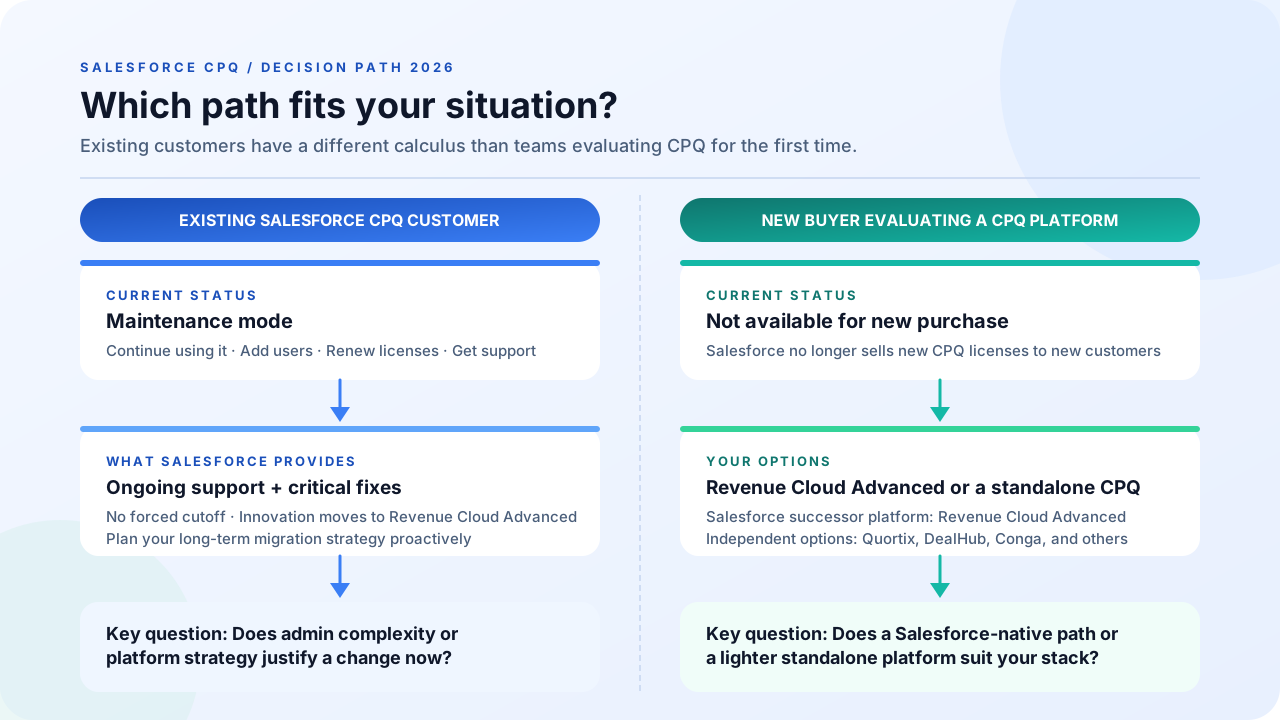
Salesforce describes Revenue Cloud Advanced, available inside Agentforce Revenue Management, as the successor to CPQ. No forced migration deadline has been announced. However, organizations that expect to expand their quoting capabilities over the coming years should factor the maintenance-mode status into their long-term platform strategy.
| Situation | What is available | What is not available |
|---|---|---|
| Existing customer | Continue using CPQ · Add users · Renew licenses · Receive support and critical fixes | Net-new feature development inside Salesforce CPQ |
| New buyer | Revenue Cloud Advanced (successor) · Standalone CPQ software | New Salesforce CPQ licenses |
| Existing customer planning growth | Current feature set with Salesforce support · Migration resources toward Revenue Cloud | Long-term roadmap investment in Salesforce CPQ itself |
Quortix as a Salesforce CPQ Alternative
For organizations that want to replace Salesforce CPQ with a standalone platform, Quortix offers a different administration model. Business users can manage product rules, pricing tiers, discounts, and bundles directly in a visual workspace — without relying on a specialist to interpret every change.
Quortix connects external AI agents over the Model Context Protocol. A connected agent can draft catalog and rule changes from a plain-language description, prepare a proposal draft from customer requirements, and surface the changes as visual diffs for human review. There is no in-app chatbot. Every proposed change requires explicit human approval before it takes effect.
The platform exposes APIs for connecting existing enterprise systems — CRM, ERP, or other data sources — so organizations do not need to abandon their current architecture. Only deterministic, published rules run during configuration, meaning the system validates each selection against the governed catalog before it advances. That validation happens without requiring a specialist to review each deal manually.
The comparison worth making is operational: how much specialist effort does each platform require to change a pricing rule, add a product, or adjust an approval threshold? For teams that want to reduce that dependence, Quortix is worth evaluating as an alternative.
How to Move From Salesforce CPQ to Another CPQ Platform
A migration from Salesforce CPQ is a structured project, not a lift-and-shift. Teams that use a clear audit process before they begin configuration in the target system consistently avoid the most common migration pitfalls.
- Audit the existing setup. Document every product, price book, configuration rule, approval threshold, and customization currently in place inside Salesforce CPQ.
- Identify what must be preserved. Separate the commercial logic that drives real outcomes from historical workarounds that exist only because they were never removed.
- Remove unnecessary complexity. Migrating old exceptions and redundant rules is a common mistake. The new platform should reflect current policy, not accumulated history.
- Rebuild product and pricing rules. Configure the catalog and pricing model in the target system, starting with the highest-volume scenarios first.
- Reconnect existing systems. Re-establish data flows with Salesforce and any other connected applications using the new platform's APIs.
- Test real sales scenarios. Run standard deals, complex configurations, non-standard discounts, and approval chains before go-live.
- Move users gradually. Train representatives and administrators on the new workflow and monitor adoption closely in the first weeks.
Conclusion
Salesforce CPQ remains a capable platform for existing customers. The end-of-sale decision does not force anyone off the product, and Salesforce continues to provide support and critical fixes. However, the shift of new development to Revenue Cloud Advanced creates a natural moment for reviewing long-term strategy.
Any evaluation should go beyond feature comparison. The more practical questions are how quickly a team can change a pricing rule, how much specialist involvement that change requires, and how the platform handles the edge cases that arise in real sales cycles. A system that looks complete in a demonstration but requires a consultant for every modification creates a different kind of problem than the one it was meant to solve.
Organizations evaluating CPQ software for the first time will need to look beyond Salesforce CPQ. Whether the answer is Revenue Cloud Advanced or a standalone platform like Quortix depends on stack, team structure, and how much administration complexity is acceptable over time. The right system is the one that sales teams will trust and operate every day — not just the one with the longest feature list.