
Automotive Manufacturing CPQ: How It Works for Complex Vehicle Sales
How configuration rules, technical validation, pricing, and connected data turn complex vehicle requirements into a usable quote and order handoff.
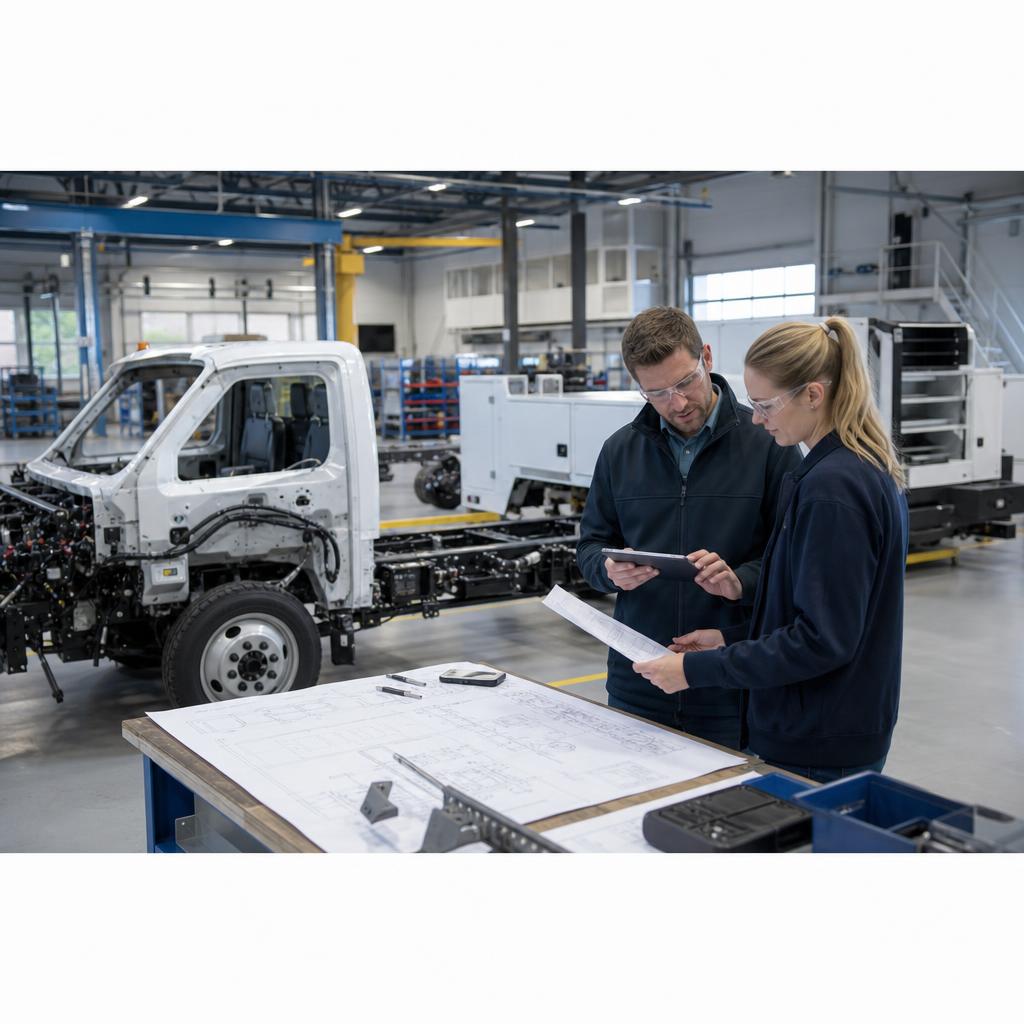
Configure, price, quote (CPQ) software helps producers of configurable vehicles manage configuration, price calculation, and quotation in one process. Beyond selecting a model, sellers must consider component compatibility, regional variants, bodywork, customer terms, and production handoff.
What Is Automotive Manufacturing CPQ?
Unlike a document generator, CPQ starts by determining what can be sold. It checks the selected vehicle against defined rules, applies commercial logic, and then prepares the offer.
For vehicle manufacturing, this approach is particularly relevant to trucks, trailers, commercial transport, and specialist bodies with interdependent options.
Why Is Automotive Quoting More Complex Than Standard Product Sales?
An engine, transmission, chassis, axle arrangement, body, and equipment package may constrain one another. Changing the body can require a different base specification or engineering assessment; regional availability adds another layer.
Sales may also wait for engineering, pricing specialists, or a body builder. Manual quoting becomes a chain of decisions, not simply a lookup.
How Does CPQ Work in Automotive Manufacturing?
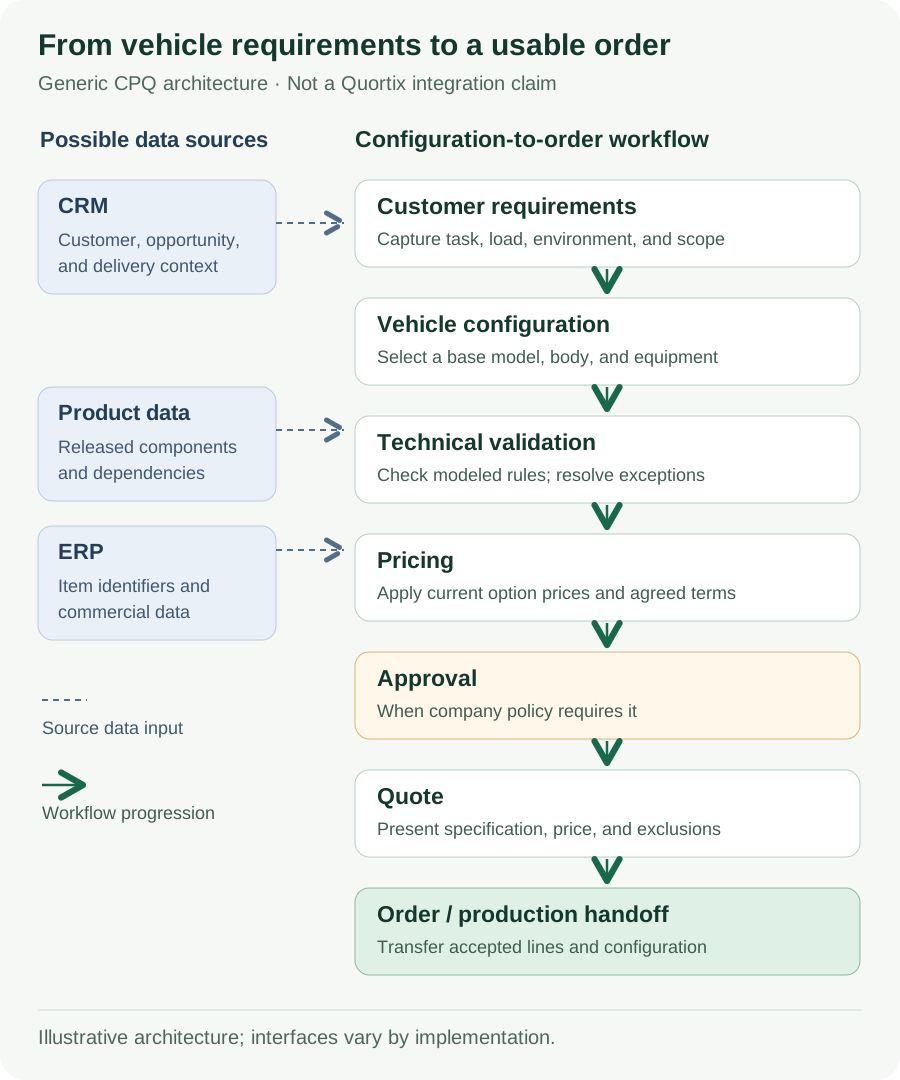
Consider a customer requesting a delivery truck with a lifting device. Sales captures the intended load, operating environment, body requirements, and service scope, then selects a suitable base model.
The system checks compatibility, calculates the valid selection, and identifies exceptions needing company approval. After review, it generates a quote; customer acceptance starts the order or production handoff.
What Problems Does Automotive CPQ Solve?
Defined rules can expose recurring process failures before an offer reaches the customer:
- Incompatible options that cannot be built together.
- Outdated pricing spread across separate price lists.
- Engineering bottlenecks around repeatable compatibility questions.
- Quote revisions requiring recalculation after specification changes.
- Approval delays and discounts outside agreed policy.
- Quote-to-order discrepancies caused by re-entering accepted selections.
These outcomes depend on maintained rules and the selected system's capabilities. Unmodeled exceptions still need expert judgment.
Where Is CPQ Most Useful in Automotive Manufacturing?
Configurability matters more than company size. The strongest case involves interacting technical choices and commercial conditions.
Specialty and Commercial Vehicles
Trucks, buses, trailers, and emergency vehicles combine a base platform with task-specific equipment. CPQ can encode repeatable dependencies while leaving unusual calculations to engineering.
Fleet and B2B Vehicle Sales
Fleet offers may vary by quantity, specification, destination, services, and customer agreement. Shared commercial rules help sellers and dealers apply the same policy.
Vehicles With Complex Options and Third-Party Equipment
A chassis supplier and body builder may own different specifications. Their dependencies need agreed identifiers and current technical data, rather than assumptions copied from an earlier quote.
What Systems Should Automotive CPQ Connect with?
Connect authoritative sources, not every available application. The following is a planning model; field ownership and interfaces must be checked against each installed system.
| System | What CPQ Receives | What CPQ Sends or Updates | Why It Matters |
|---|---|---|---|
| CRM | Customer and opportunity context | Quote reference and status | Preserves deal context |
| ERP | Item identifiers and commercial data | Accepted lines and terms | Supports order processing |
| PLM/PDM or product data source | Released components and dependencies | Selected configuration reference | Uses current product definitions |
| CAD/engineering systems | Validated technical results | Configuration requiring assessment | Separates calculation from quotation |
For context, Microsoft documents opportunity-derived quotes, SAP describes condition-based order pricing, and Siemens describes Teamcenter's CAD and component data management. These examples establish source-system roles, not ready-made CPQ connections.
Practical Example: Quoting a Configurable Commercial Vehicle
In the hypothetical delivery-truck scenario, the customer specifies payload needs, wheelbase, body, lifting equipment, and a service package. A modeled rule rejects a body-and-wheelbase pairing that falls outside engineering's approved combinations.
Sales selects an allowed alternative. CPQ combines base and option prices, applies customer or volume terms, and routes a nonstandard discount according to company policy.
The quote identifies the selected specification, service scope, and exclusions. After acceptance, structured lines and configuration identifiers move downstream without rebuilding the order manually; rejected records require resolution.
If the lifting device changes during negotiation, the seller reruns the affected checks rather than editing the document alone. Engineering confirms the revised combination where required, and the customer receives an updated offer that clearly distinguishes it from the superseded version.
“A useful quote preserves the decisions that make the vehicle buildable.”
How to Evaluate Automotive Manufacturing CPQ Software
Demonstrate a difficult product from your own range. Change an option and check dependencies, regional catalogs, prices, and the resulting quote revision.
Ask who maintains rules, how configuration versions are retained, and whether necessary external calculations can participate. Test the accepted configuration's ERP handoff and compatibility with legacy systems, including failure handling.
Have a catalog owner change a dependency during the evaluation. Can they test the change on existing examples without commissioning new code? Finally, submit an order with an obsolete component identifier: the receiving system should expose the failure and its owner, not silently substitute another part.
When Is Automotive CPQ Not the Right Fit?
A small fixed-price range with few options may need only straightforward quoting. CPQ adds little if there are no meaningful dependencies to govern.
It also cannot repair undefined catalog ownership, inaccurate prices, or an unclear review process. Legacy integration and data cleanup can outweigh the software work.
How Quortix Supports Complex Automotive Quoting
Quortix provides a visual workspace for inspecting structured product and quoting state. Published configuration and pricing rules execute deterministically.
Authorized external AI agents use the Model Context Protocol (MCP) to inspect data, simulate outcomes, and update permitted catalog, rule, and draft objects. This is not an embedded chatbot or a specialized vehicle calculation service.
Human review of consequential changes and final offers is recommended as the buyer's practice, not enforced by Quortix. Discuss your configuration requirements and system boundaries through contact.
Conclusion
CPQ earns its place when a vehicle offer depends on connected technical and commercial decisions. Evaluate whether requirements become a validated configuration that the next team can use, rather than merely a faster PDF.