
Manufacturing Quote Software: How to Quote Complex Products Faster and More Accurately
Learn how specialized quoting systems connect product configuration, pricing, approvals, revisions, and order handoff for complex products.

A quote for an engineered product is rarely a choice from a price list. Materials, dimensions, components, performance, quantity, delivery time, services, and customer requirements can affect whether the product can be built and what it should cost.
That complexity turns every quote into a small cross-functional project. A seller may need engineering to validate the design, finance to check margin, and operations to confirm lead time before the customer receives a reliable answer.
Manufacturing quoting software brings those decisions into one controlled process. Instead of using disconnected spreadsheets, email threads, and document templates, teams can move from requirements to a buildable configuration, governed price, approved offer, and usable order record.
What Is Manufacturing Quote Software?
Manufacturing quotation software is an application for creating and managing manufacturing quotes. At its simplest, it automates calculations and document creation; more capable systems also manage product configuration, compatibility, pricing logic, revisions, and approvals.
The category overlaps with configure, price, quote (CPQ). For configurable equipment, manufacturing quoting software must determine what can be sold before calculating a price, so it acts as both a commercial tool and a controlled representation of product knowledge.
This distinction matters because a polished quote can still contain an impossible combination. Effective quotation software for manufacturing validates the configuration and commercial conditions first, then uses that trusted result to generate the customer quote.
How Does Manufacturing Quote Software Work?
The process begins when a seller captures customer requirements and selects a product family or base model. Guided questions translate needs such as capacity, environment, voltage, dimensions, or destination market into structured inputs. If a requirement is unknown, the workflow should mark it as unresolved rather than quietly selecting a default.
Configuration rules then remove incompatible options and require any components needed by the chosen design. The pricing engine applies current list prices, cost or margin logic, volume tiers, customer agreements, freight, services, and permitted discounts to the valid result.
If the proposed terms cross a threshold, the quote is routed to the appropriate reviewer. Once approved, the system produces the document and passes the agreed configuration and commercial data to order management, ERP, or another downstream process.
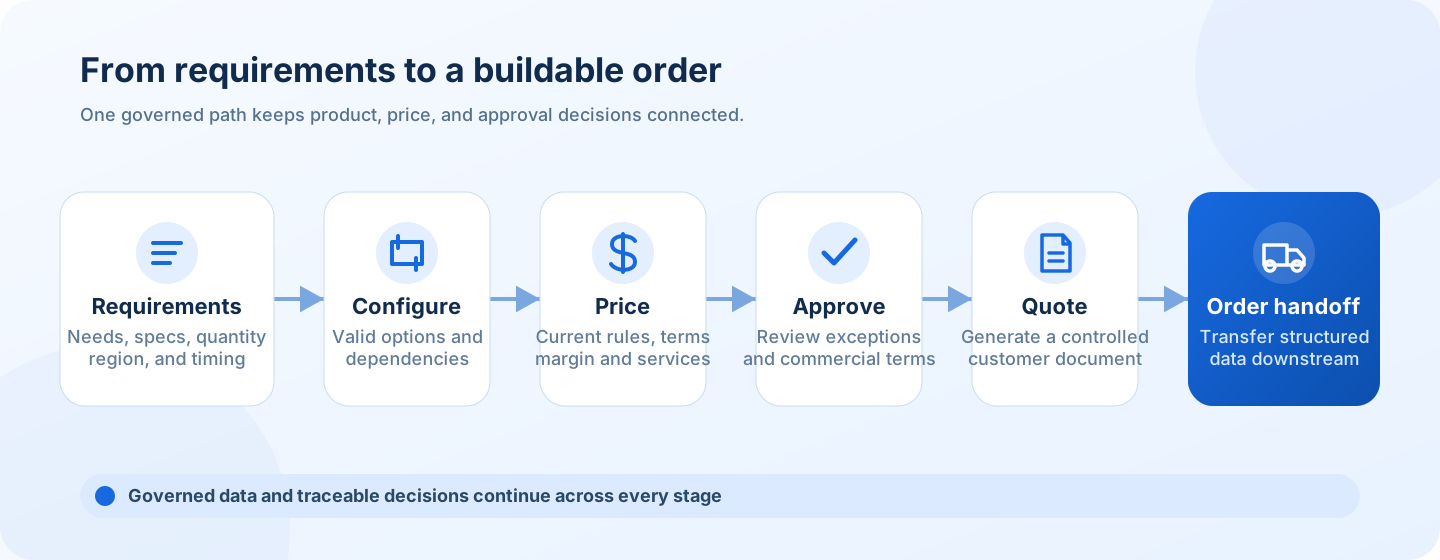
Each stage should reuse prior decisions rather than make another person interpret a PDF or re-enter lines, quantities, and options.
A useful quote record therefore contains more than line items. It connects the customer's inputs to the selected design and the price basis, allowing a reviewer to move from any quote value back to its source without reconstructing the deal.
This structure also supports controlled reuse. A sales representative can copy a prior quote as a starting point, but current rules must revalidate the new quote rather than assuming last year's design and terms remain valid.
Manufacturing Quote Software vs. Standard Quoting Software
The main difference lies in the logic before document creation. A standard program works well for fixed items and straightforward discounts, while manufacturing quoting software has to represent technical dependencies, configuration-sensitive prices, and production handoffs.
| Criterion | Standard program | Manufacturing system |
|---|---|---|
| Catalog | Standard items | Configurable products and variants |
| Compatibility | Usually not checked | Checked against defined rules |
| Price calculation | Simple prices and discounts | Price depends on configuration and conditions |
| Working with engineers | Outside the system | Can be built into the process |
| Quote changes | Basic document versions | Control of configuration, prices, and change history |
| Order handoff | May require manual input | Data can transfer to connected systems |
Product complexity is more important than company size. A smaller maker of highly configurable machines may need deeper rules than a large supplier selling standardized parts, while a simple application may remain sufficient for a stable catalog with few dependencies.
Document-first tools typically ask a rep to choose what goes on the quote. A configuration-led system first asks what the customer needs, determines what is allowed, and only then assembles the quote. That order gives sales and engineering a shared interpretation of the proposed product.
“The decisive question is not how quickly a document can be formatted, but whether the logic behind it produces something the company can build, price, and deliver.”
Key Features of Manufacturing Quote Software
Requirements should follow the product and sales process, not a generic feature checklist. Basic products may need reusable lines and calculations; engineered equipment requires constraints, price governance, and connected operational data.
Product Configuration Rules
Configuration rules define available components, attributes, and combinations. When a seller selects one characteristic, the system should include required parts, hide irrelevant choices, and block combinations that cannot be manufactured or used together.
For industrial equipment, these rules can represent load limits, material compatibility, power requirements, environmental ratings, certifications, and option dependencies. They turn engineering knowledge into repeatable guardrails without asking each seller to memorize every relationship.
Product and Pricing Rules
Pricing rules calculate from the selected design and current commercial policy. They may combine component prices, attributes, labor, quantity breaks, contract terms, regional adjustments, promotions, freight, installation, and margin floors.
The sales representative should receive a traceable result from governed logic rather than search several workbooks for a formula. Exceptions still occur, but the application should identify them, preserve the reason, and send consequential terms for approval instead of silently overriding policy.
Quote Generation and Revision Control
A quote should use the validated configuration, calculated price, customer data, scope, exclusions, and terms. This reduces discrepancies between the technical solution and what the customer sees.
Revision control is equally important because manufacturing quotes commonly change as requirements become clearer. Each quote version should preserve its configuration, price basis, author, status, and reason for change so an accepted revision cannot be confused with an obsolete draft.
A revision should create a new quote state rather than overwrite the old one. If capacity or delivery scope changes, the seller should be able to explain the technical and commercial differences.
Approval Workflows
A nonstandard discount, low margin, unusual payment term, or engineered exception may require another decision-maker. Approval logic should recognize the condition, route the quote to the right owner, and record the response.
Threshold-based routing avoids chasing reviewers through email while keeping accountability clear. A standard discount might go directly to document preparation, while a margin-floor exception goes to finance and a nonstandard component goes to engineering. The route should follow the reason for review rather than applying the same heavy process to every deal.
The approval view should show why the quote was flagged, what changed, and which evidence supports the request. A sales manager can then approve the quote, return the quote with comments, or escalate it without searching through the entire opportunity.
Guided Selling
Guided selling asks a logical sequence of questions and maps the answers to suitable products and options. It is valuable when a broad catalog makes it difficult for a sales representative to know which base model, accessory, or service fits the need.
A guided flow does not replace discovery or engineering judgment. It makes common paths consistent, exposes missing information early, and reduces dependence on a few experienced employees who currently review most manufacturing quotes.
Guidance should remain explainable: the seller needs to see why an option entered the quote and which answer caused another option to disappear. If an outdoor rating requires a different enclosure, for example, the interface should show that dependency. Sales can then correct a mistaken requirement or send a genuine exception to engineering before the customer sees the quote.
Audit Trail
An audit trail records who changed the quote, configuration, price, approval, or governing rule and when. Months later, the team can reconstruct why a specific value or term appeared and which version the customer accepted.
The record should cover the whole lifecycle, not only the final quote. That context supports dispute resolution, internal review, compliance, and analysis of where revisions repeatedly enter the sales cycle.
Comparing the original, approved, and accepted versions shows whether price, scope, or terms changed and keeps an outdated copy from becoming the production instruction.
Integration With Manufacturing Systems
Useful integrations connect CRM customer and opportunity data, ERP items and prices, product records, costing sources, engineering calculations, and order systems. The objective is not merely to attach the finished quote to another record.
A sound design synchronizes the identifiers and structured configuration needed downstream. For every connection, document which system owns each field, whether transfer is immediate or scheduled, how retries avoid duplicate orders, and who resolves rejected records. A connector list alone says little about this operating behavior.
The handoff test should start with an accepted quote and follow it into the receiving system. Confirm that every quote line maps to a recognized item, the quote revision is identifiable, and operations receives the attributes needed to fulfill the order.
How to Choose Manufacturing Quote Software
Before evaluating vendors, map the current process from incoming customer requirements to approved configuration and order handoff. Identify who supplies each fact, where work waits, which errors are expensive, and which system is authoritative.
Ask each vendor to demonstrate a real, difficult product rather than its simplified sample. A credible test includes dependencies, an exception, a revision, an approval, and a downstream transfer; it should show how administrators maintain the model after launch.
- Product Complexity: Can the model express real component and attribute dependencies?
- Pricing Complexity: Does it support current price, discount, volume, and customer-specific rules?
- Engineering Constraints: Does it block technically invalid selections?
- Revision Management: Are versions and reasons for changes retained?
- Approval Requirements: Can required routes and thresholds be configured?
- Data Sources: Where will product, customer, cost, and price data originate?
- Quote-to-Order Handoff: How does the approved configuration reach the next stage?
- Rule Administration: Who can safely maintain the catalog and logic after implementation?
- Testing and Simulation: Can a new rule be tested before sellers use it?
- Scalability: How easily can teams add products, variants, regions, and markets?
Also compare ownership effort. Quoting software for manufacturing can look flexible yet require developers for each rule change, so test administration, permissions, migration, and release controls alongside seller speed.
Be cautious with promises of instant quotes. Time a standard configuration separately from an engineered exception: the first should move with little intervention, while the second should expose missing facts and reach the correct reviewer. Speed is useful only when source data is current, constraints are complete, and customer-facing changes retain an accountable reviewer.
A pilot of software for manufacturing should involve sales, engineering, finance, and operations. Have each group inspect one difficult quote, change a requirement, approve the resulting exception, and trace the accepted lines into the receiving system. Record mismatches and the owner who would fix them; this reveals whether the model supports daily work rather than only a prepared demonstration.
Quortix for Manufacturing Quoting
Quortix is a CPQ environment for complex configurable products. It brings product structure, constraints, pricing rules, and quote work into one governed workspace, including component dependencies, eligibility, lead-time and freight logic, services, and warranties.
Published rules deterministically block invalid combinations and apply their commercial logic. Authorized external agents use MCP to inspect data, simulate outcomes, and update permitted catalog or rule objects. Teams can inspect product and pricing relationships in the visual workspace. Quortix for industrial equipment addresses configurable industrial offers.
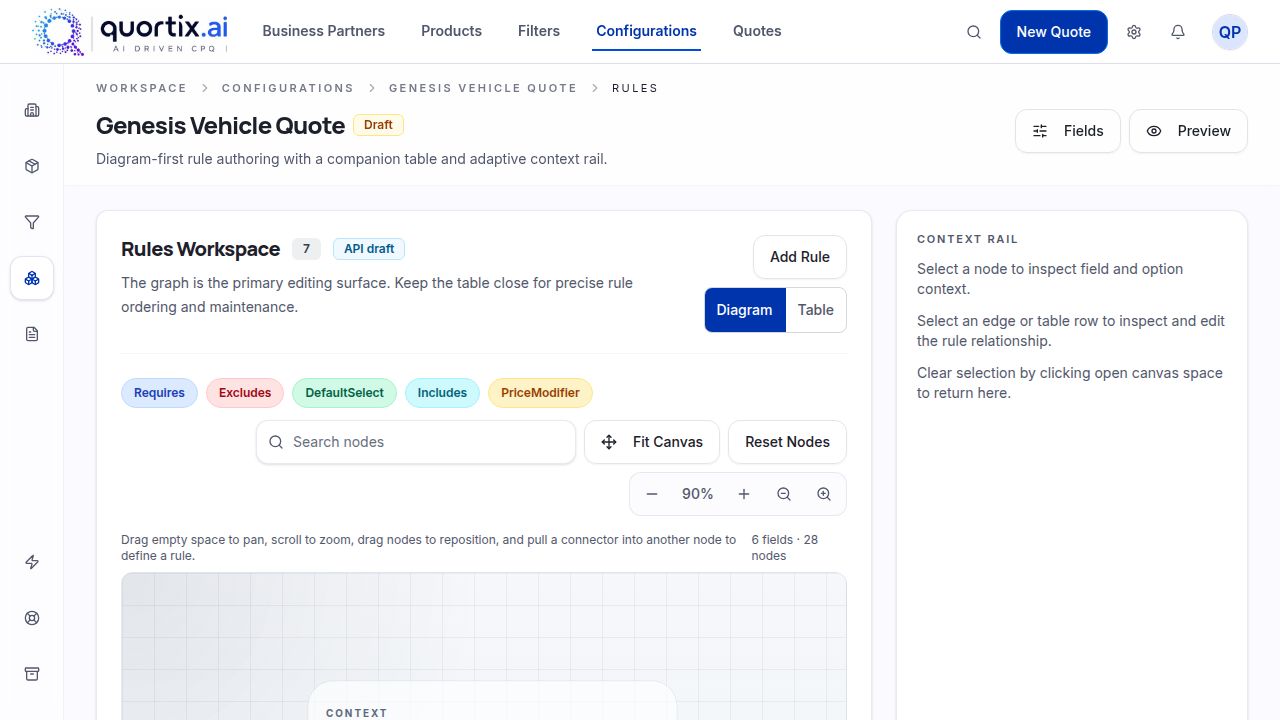
External AI agents use the Model Context Protocol (MCP) to inspect data, simulate outcomes, update permitted catalog or rule objects, and prepare draft quote objects from customer requirements. The visual workspace shows that work. Published rules execute deterministically rather than relying on a model to improvise prices or compatibility.
For consequential or customer-facing changes, teams should define their own human review and approval practice, keeping an expert responsible for unusual configurations, exceptions, and the final offer. Quortix provides visual rule management, not autonomous execution or a mandatory approval workflow.
Quortix is relevant when sales teams face product variation that exceeds what spreadsheets or document-only tools can govern. Its role is to preserve product and pricing logic through a draft quote and structured handoff, with review practices set by the buyer.
Conclusion
For a producer, the value of manufacturing quoting software is not primarily a better-looking document. It is the reliable sequence of configuration, calculation, governance, and transfer that happens before and after that document is created.
Evaluate the system on a quote that normally creates rework: an incomplete requirement, a dependent option, a commercial exception, and a customer revision. If rules expose the missing decision, prices come from governed sources, versions remain traceable, and operations receives the accepted configuration intact, the workflow is doing more than formatting a document.