
CPQ and Subscription Management: How They Work Together Across the Customer Lifecycle
Understand where quoting ends and the active customer lifecycle begins, with practical guidance on amendments, co-terming, renewals, and data ownership.

CPQ and subscription management handle different parts of the recurring revenue process. CPQ determines what is sold, at what price, and on which terms when a deal is created or changed. The lifecycle layer maintains the active agreement afterward: its dates, quantities, permitted changes, and status.
The connection matters because accepting a quote is only the beginning. A customer may add users, switch packages, renew, or cancel. Each event needs both a commercial decision and an accurate record of what the customer can use.
What Is the Relationship Between CPQ and Subscription Management?
Think of two stages in one revenue process. Configure, price, quote establishes a valid offer using product dependencies, rate rules, discounts, and contract terms. Subscription management maintains the purchased state between commercial events, including future effective dates and eligibility for changes.
A proposal describes an intention; an active record describes an obligation. Mixing these roles can activate an unaccepted expansion or leave a completed purchase invisible to the service team. The benefits come from a reliable handoff, not simply from placing both functions on one screen.
Where Does CPQ End and Subscription Management Begin?
For a new sale, CPQ selects the plan, license count, add-ons, discount, and term, then produces a quote. Negotiation and any required business approval happen before the accepted terms become a contract or order.
Activation transfers those terms into the operational record. It must identify what was purchased, when access starts and ends, and which changes the agreement permits. A quote marked accepted is not, by itself, evidence that provisioning succeeded.
How Does the Subscription Lifecycle Work After the Initial Quote?
The broad sequence is initial quote → contract or order → active subscription → amendment or expansion → renewal → cancellation or continuation. Commercial steps recur when terms change; routine operational events need not restart negotiation.
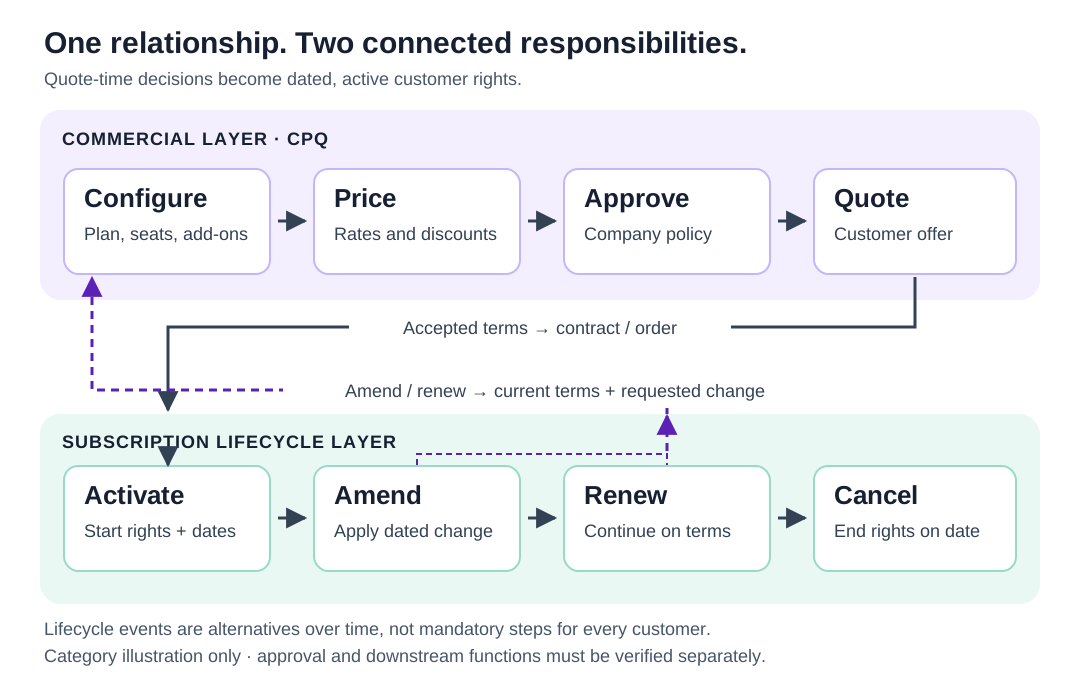
Continuation may be automatic under the contract or require a newly accepted offer. Cancellation also needs an effective date: stopping future access is different from deleting the commercial record or deciding whether a credit is due.
Which Subscription Changes Need CPQ Logic?
A contact update usually needs no quote. Adding a chargeable module or changing a negotiated discount does. Route changes through commercial rules and the company's approval policy when they alter price, product eligibility, or contractual commitments.
Amendments and Upgrades
An amendment can add or remove users, change a plan, or expand a bundle. CPQ should evaluate the revised configuration and its financial effect; the lifecycle record applies the accepted change to the existing contract or asset.
Proration is not one universal formula. Calendar-day allocation, monthly conventions, credits, and minimum charges depend on contract terms and the downstream calculation engine. Establish whether a downgrade is allowed immediately, at the next period, or only at term end.
Renewals and Price Changes
A renewal can change quantity, product mix, discount, or duration. Define the baseline and any contractual uplift before generating the next offer, including whether the increase applies to list rates or negotiated rates.
Kugamon's official edition page describes automated renewal opportunities and orders, co-termed expansions, and renewal price uplifts on Salesforce. These are vendor-specific capabilities, not assumptions about every CPQ product; confirm settings and edition scope during evaluation.
Co-Terming and Contract Alignment
Co-terming gives an added product or expansion the same end date as an existing contract. For B2B SaaS accounts adding seats throughout the year, it can consolidate purchasing decisions without treating every addition as a fresh annual commitment.
RevOps should define the effective date, permitted partial-term treatment, and alignment with invoice periods. A shared end date does not necessarily imply a shared charge frequency, and consolidating contracts must not silently remove negotiated rights.
“A new quote changes the promise; the active record must change with it.”
How Do CPQ, Subscription Management, and Billing Differ?
The following table separates typical responsibilities, not mandatory product boundaries. A suite may cover several columns, while a smaller stack assigns each responsibility to a separate owner.
| Capability | CPQ | Subscription Management | Billing |
|---|---|---|---|
| New subscription configuration | Select valid offer | Activate purchase | Receive charge terms |
| Pricing and discounts | Calculate offer | Retain agreed terms | Apply contracted charges |
| Quote generation | Create proposal | Supply active context | Not primary role |
| Amendments | Evaluate new terms | Apply dated change | Adjust charges |
| Renewal management | Prepare next offer | Track expiry and continuation | Continue agreed charges |
| Subscription status / entitlement tracking | Propose scope | Maintain active rights | Track payment state |
| Billing schedule | Capture cadence | Supply effective dates | Maintain charge timing |
| Invoice generation | Not primary role | Supply active terms | Generate invoice |
| Payment collection | Not primary role | Receive payment status | Collect and reconcile |
| Cancellation handling | Evaluate commercial effect | End rights on agreed date | Stop charges; assess credits |
Historically, Salesforce's edition page listed catalog, rates, quotes, invoices, and payments together. Its current broader offering presents Revenue Cloud, now Agentforce Revenue Management, across the lifecycle. Confirm current availability with the vendor rather than treating older edition pages as a purchasing guide.
How Should Subscription Data Flow Across the Revenue Stack?
For RevOps and sales operations, the challenge is preserving one customer state across CRM, CPQ, contracts, active records, and finance. Assign ownership by field: CRM owns account and opportunity context; the catalog owner maintains product definitions; the accepted agreement governs contracted rates and renewal terms.
The lifecycle source of truth should own start and end dates, quantities, entitlements, and amendment history. Finance owns invoice timing. Systems exchange stable account, product, contract, and event identifiers, so a retry does not create duplicate seats or charges.
Record both when a change was entered and when it takes effect. Reconcile failed transfers explicitly, and show which record prevails when systems disagree. These controls are especially important for backdated changes and accounts with multiple contracts.
Practical Example: From Initial Quote to Renewal
Consider an illustrative annual agreement for 100 licenses plus an analytics module. Assume $120 per license per year, a negotiated 10% seat discount, and a $2,000 annual module fee with no discount. The accepted starting total is $12,800.
After four complete months, the customer adds 30 licenses. For this example only, the contract allocates seat charges by whole months, retains the original discount, and co-terms the addition for the eight months remaining.
| Lifecycle Event | Quantity | Term Remaining | Pricing Action | Resulting Subscription State |
|---|---|---|---|---|
| Initial quote and approval | 100 + analytics | 12 months | 100 × $120 × 90% + $2,000 = $12,800 | Proposed; not active |
| Accepted order and activation | 100 + analytics | 12 months | Carry accepted terms | Active for agreed dates |
| Expansion after month 4 | +30; total 130 | 8 months | 30 × $120 × 90% × 8/12 = $2,160 | 130 seats; original end date |
| Next-term offer | 130 + analytics | New 12-month term | Illustrative 5% seat uplift: 130 × $108 × 1.05 + $2,000 = $16,742 | Pending acceptance |
| Accepted continuation | 130 + analytics | 12 months | Apply accepted next-term rates | Extended through new end date |
The expansion adds $2,160; it does not replace the original $12,800 commitment. Before renewal, the seller checks the current 130 seats and unchanged module, then applies the assumed uplift to the discounted seat rate only.
What Should RevOps Evaluate in CPQ Subscription Management?
Start with real events rather than a feature list. Ask shortlisted tools to manage an expansion, a backdated correction, a downgrade, and a cancellation against the same account. Inspect both the offer and the resulting active record.
- Dates and amounts: Test effective dates, required proration, co-terming, next-term rates, and exception approvals.
- Ownership and handoffs: Identify the active source of truth, change history, finance transfer, and failed-event recovery.
- Operational control: Check who can change product and pricing rules, and how lifecycle changes are tested before production.

When Is Full Subscription Management Unnecessary?
A separate layer may be excessive for simple subscription services with fixed terms, few midterm changes, and one charge cadence. An existing billing platform may already maintain enough lifecycle state; add complexity only when commercial changes justify it.
Software cannot resolve an undefined contract policy. Decide how upgrades, downgrades, cancellations, credits, and term extensions work first. Otherwise automation merely repeats ambiguity faster, leaving operations to negotiate exceptions after the customer has already received an incorrect result.
How Quortix Can Support Subscription-Based Quoting
Quortix is relevant to the commercial layer: catalog objects, rules, and quote drafts in a visual workspace. Treat initial, expansion, and next-term scenarios as evaluation cases to model, not as evidence of a built-in lifecycle ledger.
Authorized external AI agents use MCP, the Model Context Protocol, to inspect data, simulate outcomes, and update permitted catalog, rule, and draft objects. Published rules execute deterministically. Teams can inspect logic through the visual rules engine; human review before publication is recommended, not an enforced approval gate.
Do not infer automated term extensions, prorated charges, invoice processing, or active entitlement tracking from this workflow. Keep those responsibilities with verified downstream systems. Contact Quortix to discuss the commercial objects and scenarios your team needs to evaluate.
Conclusion
CPQ establishes the commercial decision; subscription management maintains customer state between decisions. The useful connection is consistent product, price, and contract data across the initial offer, amendments, and later terms—not an assumption that one application owns every step.