
CPQ for Usage-Based Pricing: How It Works, Pricing Models, and Best Practices
Learn how CPQ structures usage-priced offers, models expected scenarios, governs commercial terms, and hands signed agreements to metering and billing systems.

A fixed license fee does not fit every modern product. Cloud infrastructure may be sold by compute hour, an API by request, a data platform by gigabyte processed, and an automation service by completed operation. In each case, the customer pays in relation to measurable usage rather than only for access.
That flexibility makes the commercial agreement more demanding. A seller must capture the unit, rate, included allowance, tiers, minimum commitment, overage treatment, service dates, and any negotiated exceptions. Those details need to remain consistent from proposal through renewal, even though the final payable amount is not known when the agreement is signed.
Usage based pricing turns a price into a governed formula. Configure price quote software provides the structure for defining that formula, testing expected scenarios, obtaining approval, and expressing the result clearly to a buyer. This guide explains what belongs in CPQ, what belongs downstream, and what capabilities matter when evaluating a platform.
For buyers, the central benefit of usage based pricing is alignment: spend can rise as usage or value rises. For suppliers, it can reduce an initial adoption barrier and expose expansion potential. The tradeoff is less certainty for both sides, so the contract needs a precise formula and understandable examples rather than a single attractive headline rate.
What Is CPQ for Usage-Based Pricing?
This CPQ approach is configure price quote technology adapted to offers whose cost depends partly or entirely on measurable consumption. It helps sellers select a valid product, apply the agreed calculation method, and create a quote that describes how future amounts will be determined.
Traditional CPQ often starts with a SKU and a fixed recurring or one-time price. Usage based pricing adds variables: the unit being counted, bands or thresholds, an included quantity, a committed spend, and the rate above that commitment. The system must also manage effective dates, currencies, customer segments, and negotiated terms without leaving the seller to reconstruct a spreadsheet.
Teams adopt usage based pricing when the measure is meaningful to the buyer and observable in the product. Before publishing a commercial policy, they should test the proposed unit against quiet, typical, seasonal, and unusually active accounts. If customers cannot forecast the measure or the product cannot record it consistently, a fixed or committed structure may be easier to operate.
The phrase configure price quote describes three connected controls. “Configure” identifies the eligible product and commercial structure. “Price” evaluates the structure for a stated scenario. “Quote” records the terms the customer can accept. A platform that supports usage based offers should perform all three while preserving an auditable definition of the agreement.
CPQ does not observe every event after purchase. It defines the contract at quote time. A metering service later records actual usage, and a billing engine applies the signed formula to that activity. Keeping this boundary clear prevents an estimate in a proposal from being mistaken for a future invoice.
Common Usage-Based Pricing Models CPQ Should Support
Usage based pricing is a family of approaches, not one formula. A vendor may charge a constant amount per event, lower the marginal rate at higher volumes, sell prepaid blocks, or combine a platform fee with variable consumption pricing. Product economics and the customer's need for predictability determine the right balance among these pricing models.
| Model | How cost is calculated | What CPQ must capture |
|---|---|---|
| Pay per unit | Customer pays for each unit consumed | Measurement unit and rate |
| Tiered price | Different rates apply across consumption bands | Tier boundaries and each band's rate |
| Volume price | One rate is selected from total volume reached | Thresholds and corresponding rates |
| Minimum commitment + overage | Customer commits to a minimum, then pays above it | Commitment, included volume, and overage rate |
| Prepaid volume | Customer buys a defined block of units in advance | Package size, price, validity, and drawdown terms |
| Mixed model | A fixed component is combined with a variable one | Every component of the commercial offer |
In a pay-per-unit design, the arithmetic is simple but the definition of a billable unit may not be. A request might count only when successful, a compute minute may be rounded, and a transaction may have different rates by region. This is often called metered usage pricing when product events are the source for the eventual charge.
Tiered pricing can be graduated or stairstep. With a graduated approach, units in each band receive that band's rate, much like tax brackets. With a stairstep design, crossing a threshold selects a packaged amount for the entire band. The quote should state which interpretation applies because identical thresholds can otherwise produce different totals.
Volume pricing chooses a rate according to the total quantity reached, then commonly applies it to all units. This differs from tiered pricing, where multiple marginal rates can appear in one calculation. A simulation should make the difference visible around thresholds, where a small change in quantity may materially affect estimated cost.
A minimum commitment gives the supplier predictable revenue and the buyer an agreed capacity or spend. If activity exceeds the included amount, usage charges apply at the contracted overage rate. Prepaid blocks shift more consideration upfront and require clear expiration, rollover, replenishment, and drawdown language.
A mixed model combines a fixed platform fee with a variable component and may add implementation or support. Other usage based models include multi attribute pricing, where region, product class, service level, or time changes the rate; performance based pricing, where payment follows a verified result; and an outcome based design tied to business value. These require particularly precise definitions and evidence.
Most subscription businesses do not choose only one of these pricing models. They combine them by product line or customer segment. CPQ therefore needs flexible pricing models in a shared catalog rather than a separate manual calculator for every offer; otherwise an amendment can easily apply the rules for the wrong segment or product generation.
The best usage based models also reflect how customers budget. Pure usage based pricing maximizes variability, while a commitment or base fee creates a planning floor. Consumption based pricing can sit inside either structure. When comparing pricing models, teams should examine customer comprehension, revenue predictability, gross-margin exposure, and the operational ability to measure the chosen unit.
No single option makes usage based pricing universally fair or simple. Evaluate alternative pricing models with real customer distributions, including quiet accounts and extreme outliers, before committing the design to a catalog.
How CPQ Supports Usage-Based Pricing
The quoting workflow begins with a commercial hypothesis and ends with accepted terms. It may use expected consumption to illustrate possible spend, but it should never manufacture actual events. The sequence below shows where quote-time design stops and post-sale operations begin.
In practice, usage based pricing requires collaboration among product, finance, legal, sales operations, and engineering. Product defines the value measure, finance tests the economics, legal makes the definition enforceable, and technical teams establish the event source. CPQ converts those decisions into a repeatable selling process.
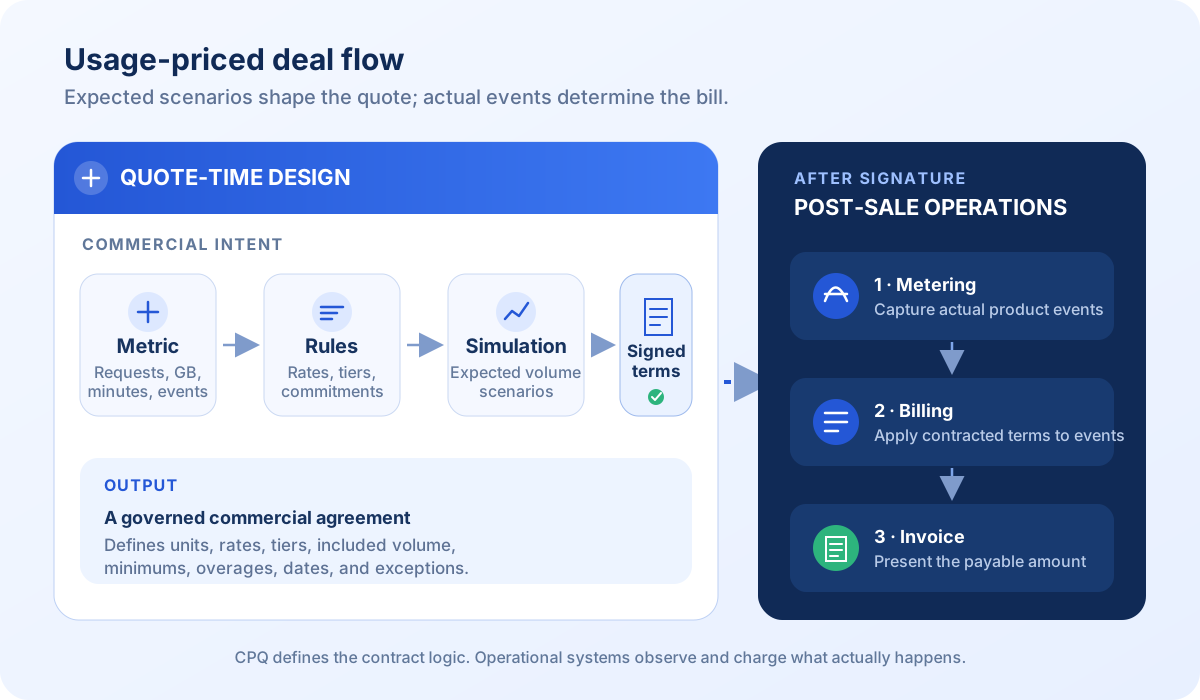
Define the Usage Metric
First define what the customer consumes: API calls, records processed, active devices, compute time, storage, messages, or another observable unit. The definition should specify valid events, exclusions, rounding, aggregation period, timezone, and the source of truth. A vague metric creates disputes no calculation engine can resolve.
The unit should also connect to value. Customers understand consumption based pricing more readily when the measure tracks a benefit they recognize. Revenue teams should test whether buyers can forecast the unit and whether product systems can record it consistently.
Configure Pricing Rules
Next, model rates, tiers, thresholds, included amounts, minimums, credits, and overages. The same pricing rules should produce the same answer for every seller and channel. Effective dates and versioning matter because a rate change for new business must not silently rewrite an existing contract.
A robust engine can represent tiered pricing, consumption rate tables, segment-specific rates, and eligibility conditions without embedding arithmetic in a proposal template. That separation lets an operations owner update commercial logic while maintaining pricing transparency for reviewers.
Combine Fixed and Variable Charges
Many agreements pair an annual platform subscription with variable consumption pricing, onboarding, support, or professional services. CPQ should place these components in one coherent offer, give each the correct term and billing cadence, and make dependencies explicit.
This is more than adding line items. A discount on the base subscription may not apply to overages; services may be one-time; and committed credits may cover one product but not another. The quote needs to preserve those boundaries for downstream interpretation.
Model Expected Customer Usage
A seller can model low, expected, and high scenarios to help a buyer understand exposure. For example, the proposal may show estimated monthly cost at 1 million, 3 million, and 6 million API calls. This quote usage is an assumption used for comparison, not a record of activity.
“A quote-time scenario explains the formula; only measured post-sale activity can determine the bill.”
Scenario analysis is especially useful around tier boundaries, commitments, and prepaid exhaustion. It can reveal a cliff, an unintended discount, or a point where another package is better. The estimate should label assumptions and avoid presenting a single forecast as certainty.
Generate the Quote
The final document should state the metric, rate, calculation method, included quantity, minimum, overage, measurement interval, effective dates, and renewal treatment. If activity affects the estimate, the document should show examples without implying that those examples are guaranteed totals.
Good configure price quote software also records approvals and the rule version behind each line. The buyer receives understandable commercial terms, while finance receives structured data rather than prose it must reinterpret after signature.
Pass Pricing Terms to Downstream Systems
After acceptance, the contracted definition must flow to the customer system, entitlement service, meter, and billing platform. Structured fields should carry units, bands, rates, minimums, dates, and account identifiers. A PDF can remain the legal artifact, but it should not be the only machine-readable source.
This handoff is where configure price quote software for usage based billing earns operational value. CPQ sends the formula and scope; it does not invent actual quantities. Clear identifiers and effective dates reduce mapping errors when an account expands, switches a package, or renews.
The distinction is essential to trustworthy usage based pricing: the quote governs the method, while observed usage supplies the later input. Neither should overwrite the other.
CPQ vs. Usage Metering vs. Billing
CPQ, metering, billing, and invoicing participate in one revenue process, but they solve different problems. Treating them as interchangeable leads to duplicated logic, mismatched totals, and unclear ownership. The simplest architecture assigns one authoritative responsibility to each stage.
| Stage | Primary responsibility |
|---|---|
| CPQ | Defines products, consumption units, rates, tiers, discounts, and commercial terms |
| Metering | Records the customer's actual product usage |
| Billing | Matches measured activity to contracted logic and calculates the payable amount |
| Invoicing | Creates and delivers the customer statement for the applicable period |
CPQ answers, “What did the parties agree?” Metering answers, “What happened?” The billing engine answers, “What does the agreement make that activity worth?” Invoicing presents the resulting receivable, tax, payment terms, and supporting detail to the customer.
A warehouse may supply analytics for revenue planning, but it should not quietly become another contract engine. Similarly, usage based billing may offer catalog features, yet sales still needs guided configuration, document generation, negotiation controls, and approval workflows. Integration is preferable to ambiguous ownership.
Procurement searches can add confusion. Labels such as subscription billing quoting, chargebee billing powered, or agentforce revenue management may point to broad suites, integrations, or ecosystem pages rather than one consistent system boundary. In a demonstration, ask where the signed rate table lives, where events are counted, and which record controls a recalculated bill.
Key CPQ Features for Usage-Based Pricing
Assigning a number to a product is not enough. Usage based pricing requires versioned calculation logic, boundary-case simulation, approval evidence, and reliable handoffs. The useful test is whether an owner can explain one quoted estimate, change a future rate without altering an active contract, and pass both versions downstream unambiguously.
Inspection of usage based pricing should start from the deal, not from a catalog-wide rule list. A reviewer should be able to select a quoted amount and see the metric definition, tier, effective date, exception, and pricing rules that produced it.
That trace makes usage based pricing reviewable by finance and product owners: CPQ explains the commercial estimate, while the meter supplies actual activity later.
Flexible Pricing Rules
The engine should support per-unit rates, graduated and stairstep tiered pricing, volume thresholds, packages, credits, and attribute conditions. It should also handle time-bound promotions and different price books without forcing a seller to calculate adjustments externally.
Treat no code configurability as an operating test, not a label. Ask a business owner to add a tier, inspect affected offers, simulate quantities on both sides of the boundary, and publish through the normal approval path. A friendly form over opaque scripts does not remove specialist dependency.
Minimum Commitments and Overage Rules
A commitment can be a spend, quantity, or prepaid credit balance. CPQ should record what is included, whether unused value rolls over, when the commitment resets, and how excess is charged. It should also distinguish hard limits from soft limits that permit continued service.
Overage logic needs the same precision as the headline rate. Dynamic usage charges may vary by band or product family, and usage schedules may reset monthly even when the contract is annual. Those details affect both the customer's expectation and billing accuracy.
Hybrid Pricing
Many teams use hybrid pricing models to combine predictable recurring revenue with a variable value measure. A typical offer includes a platform fee, a committed allowance, an overage rate, and implementation services. Another may combine seats with API calls or storage.
The system should model these as related components with independent terms, not flatten them into one unexplained amount. This helps the customer understand the fixed floor and variable exposure while giving operations clean instructions for fulfillment and billing.
Quote Simulation
Simulation evaluates the proposal against representative quantities before it is sent. Teams should test below, at, and above each threshold; a zero-activity period; commitment exhaustion; and the start or end of a promotion. Comparing scenarios is the safest way to validate complex consumption pricing.
For a tiered calculation, the result should show which bands fired and whether rates are marginal or volume-wide. Explainable output helps finance verify the calculation and helps a seller answer a buyer's question without reverse-engineering the formula.
Discount and Approval Controls
A seller may negotiate a lower rate, a larger included allowance, or a different minimum. The system should compare the exception with policy and route it through approval workflows when authority is exceeded. Reps should not work around controls by editing document text.
Approval context matters. Reviewers need the standard rate, requested term, estimated scenario impact, margin information when available, and reason for the exception. The accepted override should become structured contract data and remain visible during amendment or renewal.
Pricing Rule Management
Software companies adjust packaging frequently. Administrators need to create a draft, compare dependencies, test representative configurations, approve the change, and publish it for a defined date. Existing agreements should continue to reference their contracted version unless deliberately migrated. Pricing rules should retain the usage definition that applied when the agreement was accepted.
Visual management and no code configurability can shorten the feedback loop, but governance remains essential. Every change to pricing rules needs an owner, rationale, effective date, test evidence, and rollback path. That combination supports experimentation without turning live deals into tests.
Amendments and Renewals
Customer relationships evolve. A buyer may raise its commitment, add a module, change a metric, receive a temporary concession, or move to a new package at renewal. CPQ should start from the active agreement, preserve prior periods, and apply the revised terms from the correct date.
Ramped arrangements add planned changes across future periods. The quote should show each phase clearly and downstream systems should receive dated instructions. This avoids treating a scheduled increase as an ad hoc correction later.
Integrations
A credible architecture connects CRM opportunity context, CPQ contract logic, product entitlements, event collection, usage based billing, finance, and reporting. Stable product, account, metric, and contract identifiers matter more than a large list of nominal connectors.
Test amendments and failures, not only the happy path. Ask what happens when an event arrives late, a contract changes mid-period, a sync is retried, or a customer has two active rate plans. Dependable usage based billing needs a reconciliation queue, an audit trail, and an explicit owner for records that cannot be matched.
How to Choose CPQ for Usage-Based Pricing
Start with the company's real commercial model rather than a vendor's feature list. Document the unit definitions, every rate structure, exception patterns, data sources, contract lifecycle, and current reconciliation work. Then ask shortlisted products to model representative deals, including awkward edge cases.
A practical selection checklist should cover:
- Metrics: Which consumption measures are used, and can product systems capture them consistently?
- Model mix: How many payment models are combined, including fixed fees, commitments, prepaid blocks, and variable rates?
- Commitments: Are minimums, included allowances, overages, rollover, or hard limits required?
- Segmentation: Do customer groups, regions, channels, or products receive different rates?
- Change: How often do prices, tiers, and packaging change, and how are existing contracts protected?
- Enterprise exceptions: Do large deals need custom rates, terms, discounts, or multi-year ramps?
- Ownership: Who will manage the catalog and calculation logic after implementation?
- Testing: Can an owner simulate a change before publication and inspect why a result occurred?
- Handoff: How will signed commercial terms reach event collection and the billing platform?
- Lifecycle: How are expansions, midterm changes, renewals, and scheduled ramps processed?
Use real examples in the evaluation: a customer just below a tier, one above several tiers, one with no activity, and one changing plans mid-period. Confirm that the platform can produce both a clear customer document and structured downstream data. Ask who resolves a discrepancy and which system's record prevails.
During a proof of concept, compare the same usage based pricing deal across a new sale, expansion, and renewal. Verify that the system preserves old terms, introduces new dates correctly, and explains each estimate. A polished first quote is not enough if later lifecycle events require manual reconstruction.
Finally, ask a buyer-facing reviewer to read the output without assistance. Usage based pricing succeeds only when customers can understand the measure, estimate exposure, and connect a later statement to the terms they accepted.
Variable activity still needs a stable contractual definition; changing demand is not a reason for variable interpretation.
Also assess operational fit. Configure price quote products differ in administration, extensibility, implementation effort, and required specialist skills. A powerful engine that only consultants can safely modify may be a poor fit for a company that experiments every month.
Security, auditability, currency, tax handoff, and scale belong in the evaluation, but they do not replace model fidelity. The best choice is not the product with the longest capability list. It is the one that can represent the actual agreement accurately and keep it governable as the business grows.
Quortix for Usage-Based and Ramped Pricing
The category requirements described above—such as consumption tiers, commitments, ramps, overages, and customer documents—are items buyers should validate in a CPQ evaluation, not capabilities to assume from a product description. Quortix currently demonstrates catalog and price-rule objects in a visual environment.
Authorized external agents can inspect data, simulate outcomes, and update permitted catalog, price-rule, or draft objects through MCP. Teams can inspect those objects and simulation results in the visual rules engine. Deterministic published pricing rules remain the authority for calculation; teams decide their own review practice before publishing.
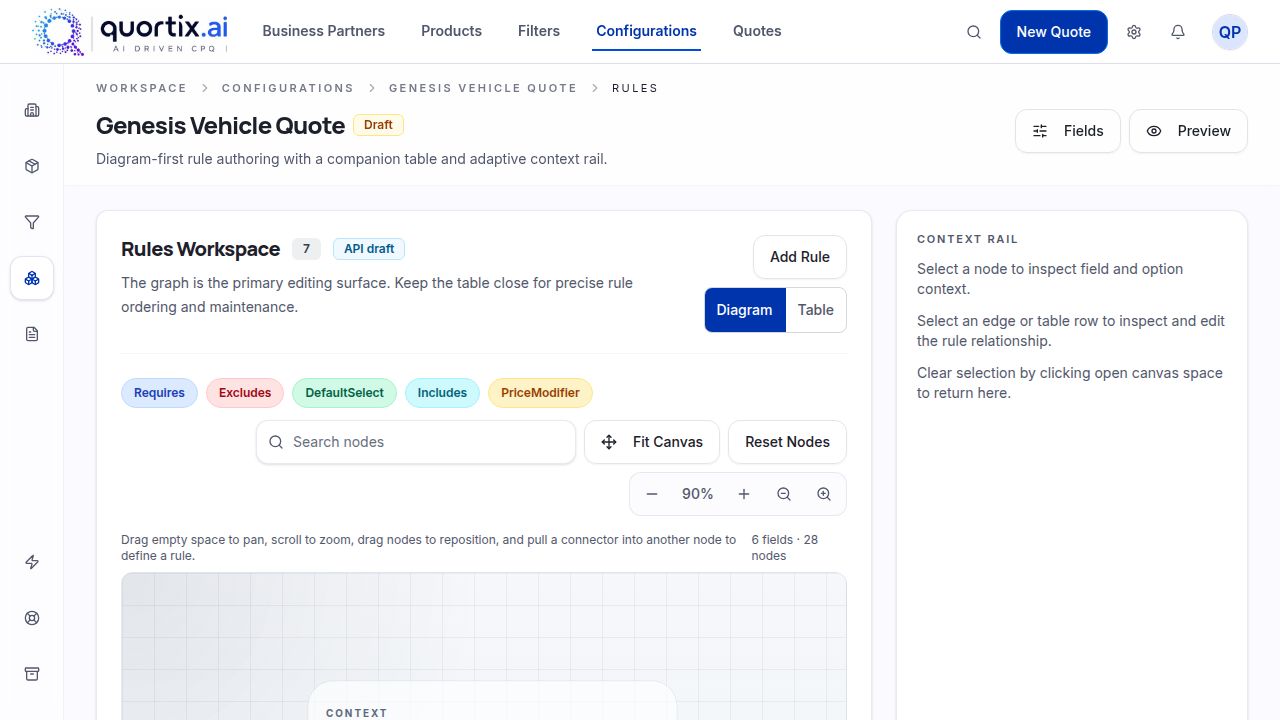
This makes the workspace useful for examining commercial logic and proposed permitted-object updates before publication. It does not by itself establish that Quortix implements a particular usage-pricing structure, promotion-combination policy, document automation, or a downstream billing handoff. Buyers should test those broader workflow requirements against their own use case.
Quortix's AI capability uses authorized external agents connected over the Model Context Protocol (MCP). They can inspect data, simulate outcomes, and update permitted catalog, rule, or draft objects. This is ai assisted pricing, not an in-app chat or copilot that silently decides customer terms.
Permitted draft objects and their configuration remain visible in the visual workspace for an operator to inspect. Buyers that require review before customer delivery should establish that process themselves, while published deterministic logic—not a language-model response—calculates the commercial result. This separation keeps AI useful for permitted updates without making it the contract authority.
Quortix does not claim to meter activity, calculate invoices, or replace event collection and billing. For usage based pricing, buyers should separately confirm how their required metric, commercial structures, documents, and operational handoffs will be represented. An expected scenario remains distinct from measured activity.
Conclusion
Usage based pricing primarily complicates the commercial logic of a deal. Units, tiers, commitments, prepaid value, overages, fixed components, and negotiated exceptions must become understandable terms that people can review and systems can execute.
Choose a platform by following one awkward agreement through its full lifecycle: simulate a threshold, approve an exception, amend it midterm, and reconcile the resulting terms with metering and billing. CPQ should preserve the signed formula; metering should record reality; billing should apply the agreement; and invoicing should communicate the amount due. If ownership becomes unclear at any handoff, the design is not ready to scale across usage based models.