
Best AI Sales Automation Software: 8 Tools for Modern Sales Teams
Compare eight AI sales tools across prospecting, engagement, administration, calls, enablement, forecasting, configuration, pricing, and quoting.

AI in sales has moved far beyond writing emails and scheduling follow-ups. Modern systems can research prospects, enrich contact records, summarize calls, update customer data, assess pipeline risk, recommend content, configure complex products, apply pricing rules, and prepare a quote for human review.
That breadth changes the buying question. There is no single product that is objectively best at every stage. The right choice depends on the sales bottleneck: weak account data, slow prospecting, inconsistent conversations, poor deal visibility, or a quoting process that still depends on spreadsheets and a few experienced employees.
This guide examines eight AI sales tools built for different workflows. We compare their primary purpose, depth of automation, integration model, implementation demands, governance, and likely fit for a small sales team or an enterprise operation. The order is not a ranking from strongest to weakest.
What Is AI-Driven Sales Automation?
AI-driven sales automation uses machine learning, language models, and agents to interpret context and decide what action should happen next. A traditional rule might send a reminder three days after a meeting. An AI workflow can read the meeting summary, identify the buyer's open questions, draft a relevant response, update the opportunity, and route a technical request to the right owner.
The difference is not that rules disappear. Reliable sales processes still need deterministic controls for permissions, pricing, product compatibility, and approvals. AI adds interpretation around those controls: it can turn unstructured information into structured work, prioritize records, generate a first draft, and explain why an action is recommended.
“The best use of AI is not to remove every human decision. It is to remove the searching, retyping, and cross-checking that prevents people from making the decision.”
For buyers, this means the category is broader than one automation platform. Some AI sales tools are systems of record, some are specialist applications, and others coordinate work across an existing stack. A useful shortlist begins with the workflow, not with the number of AI features on a product page.
Where AI Can Automate the Sales Process
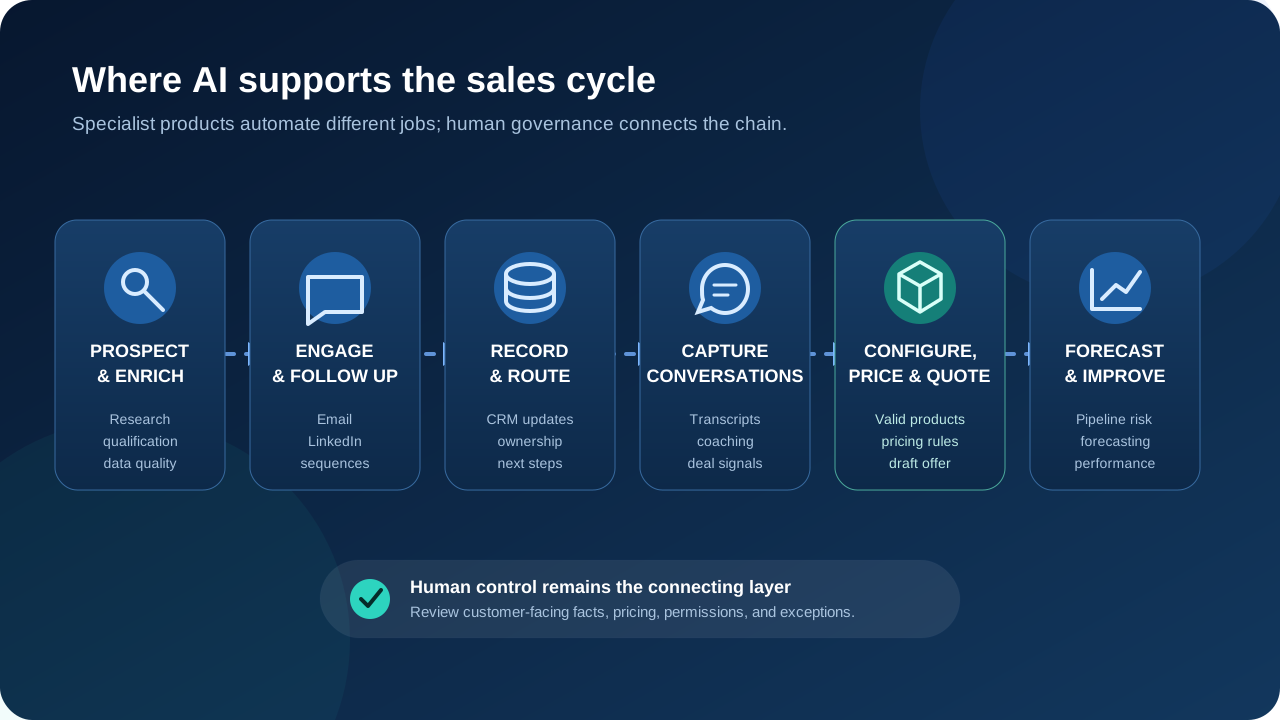
The sales cycle is a chain of distinct jobs. A product that is excellent at finding the right account may do nothing after the first meeting, while a quoting engine may create an accurate commercial offer but never source a lead. The following stages explain why very different AI sales tools appear in the same comparison.
Prospecting and Lead Enrichment
At the top of the funnel, AI searches large data sets for accounts and people that match an ideal customer profile. It can combine firmographic data, hiring activity, technology use, public signals, and internal history to identify likely buyers.
Enrichment then fills gaps and turns a raw name into a usable record. Useful systems show the source and freshness of each field, because inaccurate contact data merely automates wasted effort. Qualification models can rank enriched records, but a seller should still be able to inspect why a prospect received priority and exclude a record that does not fit.
Messaging and Follow-Ups
Engagement products create personalized email or LinkedIn sequences, vary messages by persona, and schedule follow-ups when a recipient does not respond. AI can research an account before drafting, select a relevant proof point, and adapt the next message to a reply.
This is the classic home of AI sales tools, but volume needs governance. Teams should control sending domains, approved claims, opt-out handling, and the data used for personalization. Better relevance is valuable; faster delivery of an inaccurate message is not.
Customer Records and Sales Administration
Administrative work accumulates between customer interactions: creating contacts, logging activities, updating stages, assigning owners, and capturing next steps. AI can extract those facts from emails, calendars, call notes, and forms, then propose or execute structured updates.
This is where a well-connected system of record matters. A sound workflow proposes or writes updates to the designated source of truth instead of leaving a parallel database to become stale. Sales ownership, duplicate handling, field-level permissions, and clear audit history are as important as the time saved.
Sales Calls and Conversation Intelligence
Conversation intelligence records and transcribes meetings, summarizes the discussion, captures objections, and identifies commitments. More advanced products compare patterns across calls to surface coaching signals, buyer engagement, competitor mentions, and changes in deal risk.
The best result is shared memory, not surveillance. A sales rep should leave a meeting with accurate next steps, while managers gain visibility without attending every call. Recording consent, retention policy, and access controls need to be designed before broad deployment.
Configuration, Pricing, and Quote Automation
Near the close, the problem changes from persuasion to commercial accuracy. A seller must translate customer requirements into a valid product configuration, choose the correct catalog items, apply price lists and promotions, respect discount authority, and produce a coherent offer.
General-purpose AI sales tools can summarize the need, but complex products require deterministic rules underneath. A controlled architecture lets an agent interpret the request while a CPQ engine validates compatibility and pricing. A sales manager or rep reviews the result before customer-facing terms are finalized.
Pipeline Analytics and Forecasting
Forecasting products combine opportunity fields with activity, conversation, and historical conversion data. They can flag deals with missing stakeholders, slipping dates, weak engagement, or an unrealistic close plan, then show managers where intervention may change the outcome.
The model is only as reliable as the process feeding it. A useful sales forecast exposes the signals behind a score and makes uncertainty visible. It should support judgment, not turn a probabilistic estimate into an unquestionable number.
How We Compared the Platforms
We first identified the sales stage each product automates and whether it completes work or mainly provides insight. We then considered the depth of AI, integration with customer and operational systems, implementation effort, ongoing administration, governance, and fit for a small business versus an enterprise sales organization.
Pricing was assessed as a model rather than a temporary list price. Per-user fees, usage credits, data consumption, implementation, integration work, and specialist administration all affect total cost of ownership. The best commercial fit is the one whose cost scales with measurable value, not simply the lowest starting subscription.
| Product | Primary workflow | Best fit | Typical pricing approach |
|---|---|---|---|
| Quortix | Product configuration, pricing, and quote creation | Teams selling configurable products with governed pricing | Tiered SaaS |
| Saleshandy | Prospecting and cold email sequences | Outbound teams that need focused campaign execution | Published subscriptions plus usage or data credits |
| Clay | Prospect research, enrichment, and personalization | GTM operations building data-rich prospecting workflows | Usage and credit-based tiers |
| HeyReach | LinkedIn and multichannel engagement | Teams and agencies coordinating multiple sender accounts | Plans that scale with accounts and usage |
| Lindy | Agent-led workflows across business applications | Teams automating cross-system administrative work | Task or usage-based plans |
| Gong | Conversation intelligence and revenue insights | Larger revenue organizations needing deal visibility | Custom enterprise quote |
| Highspot | Enablement, content, coaching, and seller guidance | Organizations standardizing seller execution | Custom enterprise quote |
| Salesforce Sales Cloud | Customer records, opportunities, forecasting, and workflows | Organizations centered on the Salesforce ecosystem | Per-user editions plus add-ons |
8 Leading AI Sales Tools for Different Workflows
The products below belong to different categories, so placement does not imply a universal winner. The best choice is the product that removes the highest-cost constraint in your process without creating a larger integration or governance problem.
Quortix — AI-Native CPQ and Quote Automation
Quortix specializes in the point where a qualified opportunity becomes a concrete commercial offer. It is an AI-native CPQ platform for products, pricing, configuration, and quoting, rather than a general prospecting product or a replacement for the systems used earlier in the cycle.
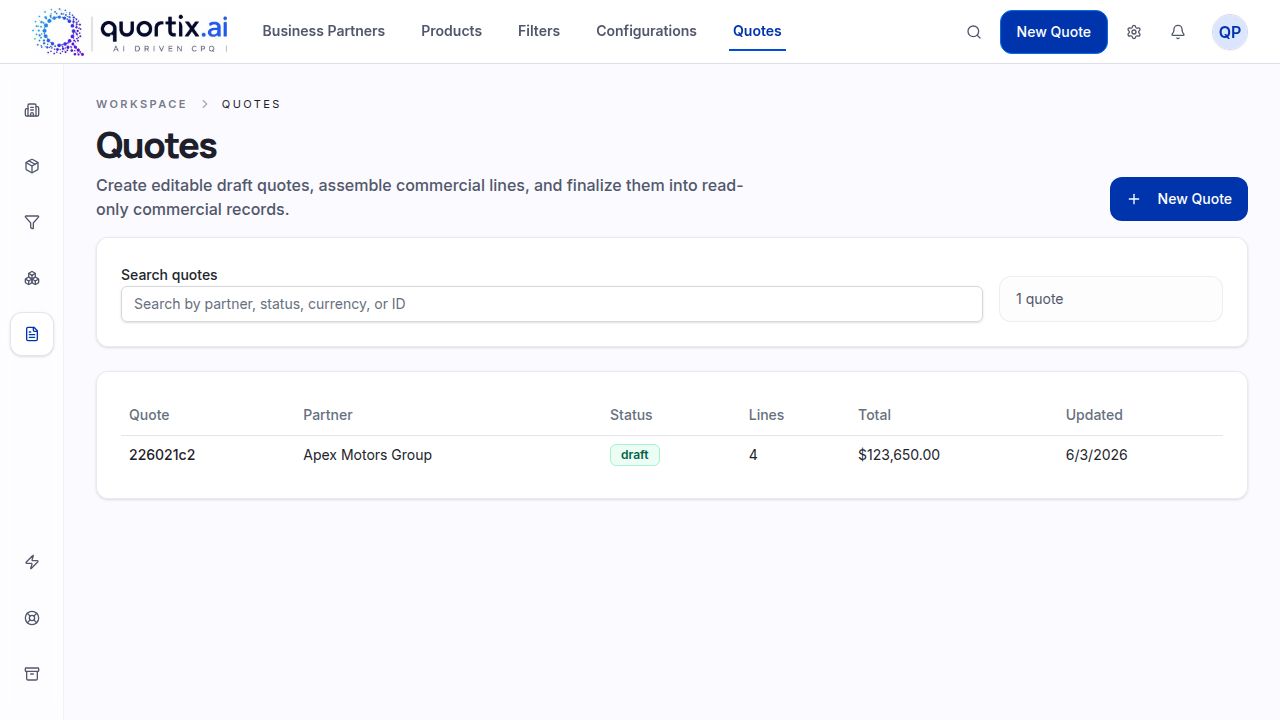
Authorized external AI agents connect to Quortix through the Model Context Protocol (MCP). They can inspect the governed product and commercial data, simulate outcomes, and update permitted catalog, rule, or draft objects from a call summary, email, or structured form. That work appears in the visual workspace. Published rules execute deterministically; a team may choose to review a draft before customer delivery.
For RevOps, the distinction is important. Business logic remains visible and governed in the workspace instead of being hidden in a prompt. The platform is designed to connect with customer and ERP processes; teams that need approval for consequential changes or customer-facing terms should establish it as an operating requirement. Among AI sales tools, Quortix belongs on the shortlist when configuration and commercial accuracy are the bottleneck.
Saleshandy — AI-Assisted Prospecting and Cold Email
Saleshandy focuses on the upper funnel. Its product combines lead finding and enrichment with cold email sequences, personalization assistance, sender management, follow-ups, and campaign analytics. It is designed for teams that want prospect data and execution in one focused environment.
The practical appeal is workflow continuity: a user can find a relevant contact, enrich the record, place it in a sequence, and monitor performance without assembling many small applications. Current capabilities also include AI-assisted message creation and connections for broader workflows.
Saleshandy belongs on a shortlist for repeatable outbound programs, especially when deliverability and campaign operations are the immediate constraint. Buyers should test sender controls, suppression handling, data quality, and CRM handoff. It complements later-stage systems; it does not validate a complex product configuration or govern a commercial quote.
Clay — AI-Powered Lead Enrichment and Research
Clay is a data and research layer for go-to-market workflows. It helps teams combine multiple data providers, enrich account and contact records, research companies, apply scoring logic, and create personalized inputs before a seller begins a conversation.
Its strength is flexibility. Operations teams can build tables that waterfall across providers, use AI to interpret public information, and produce highly specific variables for downstream messages. That makes Clay powerful, but it also means the quality of the workflow depends on how carefully the data sources and logic are designed.
Clay merits evaluation for enrichment and detailed personalization when a team has the operational skill to maintain provider waterfalls, credit use, and scoring logic. It is not intended to own the complete cycle, manage conversations after the meeting, or produce governed quotes.
HeyReach — LinkedIn and Multichannel Engagement
HeyReach is a specialist product for LinkedIn-centered outbound workflows. It coordinates sender accounts, campaigns, messages, and actions so a team or agency can run structured engagement at a scale that would be difficult to manage manually.
Integrations, API access, and an MCP approach let HeyReach participate in a wider agent workflow rather than operate as an isolated campaign screen. That can connect account selection, research, messaging, response handling, and handoff to other systems.
HeyReach is aligned with LinkedIn outreach and multichannel coordination. Buyers should evaluate account safety, review controls, and handoff quality alongside activity volume. It solves a channel execution problem, not forecasting or CPQ.
Lindy — AI Agents for Sales Workflow Automation
Lindy provides configurable AI agents that coordinate work across applications. Common scenarios include enriching a record, updating the customer system after a meeting, drafting a follow-up, routing information, or triggering the next step when a defined event occurs.
This horizontal approach differs from a specialist application. A Lindy workflow can bridge gaps between existing systems, but the organization must define the process, choose what the agent may do, and monitor failures. An AI sales assistant is most useful when its permissions and escalation path are explicit.
Lindy is relevant when the bottleneck is cross-system administrative work and the team can own permissions, monitoring, and recovery. It is an orchestration layer rather than the authoritative product catalog, pricing engine, conversation data set, or enablement repository.
Gong — Conversation Intelligence and Revenue Insights
Gong is centered on customer interactions and the revenue context around them. It captures conversations, analyzes buyer signals, surfaces deal risks, supports coaching, and contributes activity-based evidence to pipeline inspection and forecasting.
Its value is strongest after contact begins. Managers can see what buyers are discussing, which commitments are missing, and where execution differs from successful patterns. Reps receive summaries and guidance without reconstructing every meeting from notes.
Gong belongs on an enterprise shortlist when there is enough captured conversation volume to justify a shared intelligence layer. Teams should validate recorder coverage, consent, retention, CRM matching, and manager adoption. It is less relevant when the primary problem is finding prospects, cleaning data, or generating a technically valid quote.
Highspot — AI-Powered Sales Enablement and Coaching
Highspot focuses on seller effectiveness: finding the right content, learning the play, preparing for a conversation, receiving coaching, and taking a next action based on deal context. Its AI capabilities bring guidance and recommendations into the seller's work rather than leaving enablement in a separate library.
That role is different from both engagement and CPQ. Highspot helps a rep execute the company strategy consistently and helps leaders understand whether content, training, and behaviors affect outcomes. It does not exist primarily to source contacts or calculate product pricing.
Highspot is relevant to a large enterprise with a mature enablement function, distributed sellers, and a substantial content estate. The value case depends on content governance, manager participation, and seller adoption, not just deploying the platform.
Salesforce Sales Cloud — Customer-System-Centered AI
Salesforce Sales Cloud takes a system-of-record approach. Opportunity management, lead scoring, workflow automation, forecasting, reporting, and a large integration ecosystem sit around the customer record. Agentforce and Einstein capabilities add research, predictions, generated actions, and agent-led work inside that context.
The best reason to choose it is centrality. If Salesforce already coordinates operations, adding AI there can reduce handoffs and keep results attached to governed records. The tradeoff is scope: configuration, licensing, add-ons, and administration can make the total environment more complex than a focused application.
Salesforce belongs on the shortlist for an enterprise that wants a broad operational foundation and can support its licensing, configuration, and administration. Specialist products may still be needed for deep enrichment, conversation intelligence, enablement, or complex quote logic.
How to Choose the Best Platform for Your Team
Do not choose by counting AI features or by judging the smoothest demo. Start with the current sales process, identify where time or margin is lost, and define the result that would prove the investment worked.
Define the Workflow You Want to Automate
Ask one concrete question: which process consumes the most time or produces the most expensive errors? Examples include researching accounts, entering call notes, finding approved content, inspecting pipeline, or checking quotes. A narrow, measurable problem produces a better shortlist than a general instruction to “add AI.”
Document the starting metric before implementation: research minutes per account, follow-up delay, forecast variance, quote turnaround, or correction rate. Limit the first project to one segment, region, or product family so the owner can compare ordinary cases and exceptions against that baseline.
Check Integration Requirements
Map the systems that supply context and receive the output: CRM or ERP records, email, calendars, data providers, call platforms, content repositories, and AI agents. Confirm whether each connection is native, API-based, or dependent on a separate integration service.
Then test the difficult direction. Many products can read a record; fewer can write back safely, preserve ownership rules, handle duplicates, and explain a failed sync. For enterprise sales, identity, regional controls, and audit requirements should be part of the integration test.
Evaluate Human Control and Governance
Human review matters most when AI affects customer-facing facts, product eligibility, pricing, contractual terms, or regulated communication. Define which actions may run automatically, which require approval, and what evidence the reviewer receives.
The control boundary should be obvious. Users need to inspect sources, see the proposed change and downstream effect, correct it, and trace what happened later. Test an ambiguous input, a prohibited action, and an unavailable approver before rollout rather than discovering the recovery path during customer work.
Consider Implementation and Maintenance
Evaluate more than initial setup. Ask who will adjust scoring, prompts, rules, permissions, and integrations six months later. A flexible product can become expensive if every change requires a specialist, while a simpler tool may be easier for an internal owner to operate.
For an enterprise rollout, include change management, training, support, security review, and a phased deployment. A useful proof of concept uses approved real data and representative exceptions instead of a polished sample workflow that avoids the hardest cases.
Compare Total Cost, Not Just Subscription Price
Calculate subscription fees together with implementation, usage credits, data, integration, administration, security work, and any additional applications required to complete the process. Also account for the cost of keeping the existing manual step when a product automates only part of it.
Compare that total with a measurable return: hours recovered, errors avoided, faster cycle time, higher conversion, or protected margin. The best option is not necessarily the cheapest; it is the one with a defensible path from cost to business outcome.
Conclusion
Modern AI sales tools address different parts of a connected sales process. Saleshandy and HeyReach support engagement, Clay strengthens prospect data, Lindy coordinates cross-system work, Gong analyzes conversations, Highspot improves seller execution, and Salesforce provides a broad operational center.
If the problem occurs later—when complex customer requirements must become a configuration, governed price, and quote—another engagement or customer-record tool will not solve it. That is the point at which Quortix belongs on the shortlist: authorized external agents connect over MCP to inspect data, simulate outcomes, and update permitted objects; proposed work appears in the visual workspace, and published rules execute deterministically. Teams can require seller review before customer delivery. To evaluate current fit, contact the Quortix team.