
B2B CPQ Software: How It Works and When Your Sales Process Needs It
A practical guide to configuration, pricing, commercial checks, and order handoffs, with an industrial equipment example and a structured evaluation checklist.

B2B CPQ software is a system that helps companies configure a suitable product or offer, apply current pricing rules, and produce a commercial quote through a controlled process. Its value comes from automating the decisions before the document, not from making a better-looking PDF.
A seller might need to check whether a motor fits a machine, which contract price applies, and who can authorize an exception. CPQ connects those decisions so an attractive proposal does not conceal an unbuildable product or an uneconomic commitment.
What Is B2B CPQ Software?
Configure establishes what can be sold to this customer. It combines requirements, available products, compatibility constraints, and eligibility rules; selecting a valid accessory can also require a supporting component.
Price applies commercial logic to that configuration: price lists, quantities, contract conditions, discounts, and applicable charges. Even the best-looking price needs an explanation: which reduction comes from the customer's contract, and which concession is the seller asking to make?
Quote turns the checked offer into a customer-facing proposal with scope, amounts, validity, and terms. A CPQ platform should preserve the relationship between those terms and their underlying inputs, rather than treating the document as an isolated file.
Why Does B2B Quoting Become Difficult to Manage?
Complexity grows when independent decisions interact. A regional price list may use another currency, a customer contract may override a volume tier, and a delivery promise may depend on a component that engineering has just withdrawn.
The person who knows the spreadsheet best may understand every exception. That knowledge does not automatically reach a new seller or an overseas distributor; product options, customer-specific terms, volume discounts, regional pricing, and approval thresholds can arrive from different systems with different update schedules.
For manufacturers, the consequence can extend beyond a pricing error: production may receive incompatible options or an incomplete equipment specification. Repeated clarification between sales, finance, and engineering is evidence that the decision process needs attention, even when quote volumes remain modest.
Look for the point at which information loses its meaning. A note saying “include installation” may mean labor only to sales but labor, travel, and site preparation to the customer; converting that note into defined scope is a process improvement that should precede document automation.
How Does B2B CPQ Software Work?
The general sequence is Customer requirements → Valid configuration → Pricing → Commercial checks → Approval → Quote → Order handoff. Approval here means the company's authorization step, whether implemented in the selected system or handled through another documented process.
Product and pricing teams define reusable rules before sellers prepare offers. The platform evaluates those rules against each deal, identifies missing information, and calculates the permitted result instead of asking the seller to reconstruct the logic from separate references.
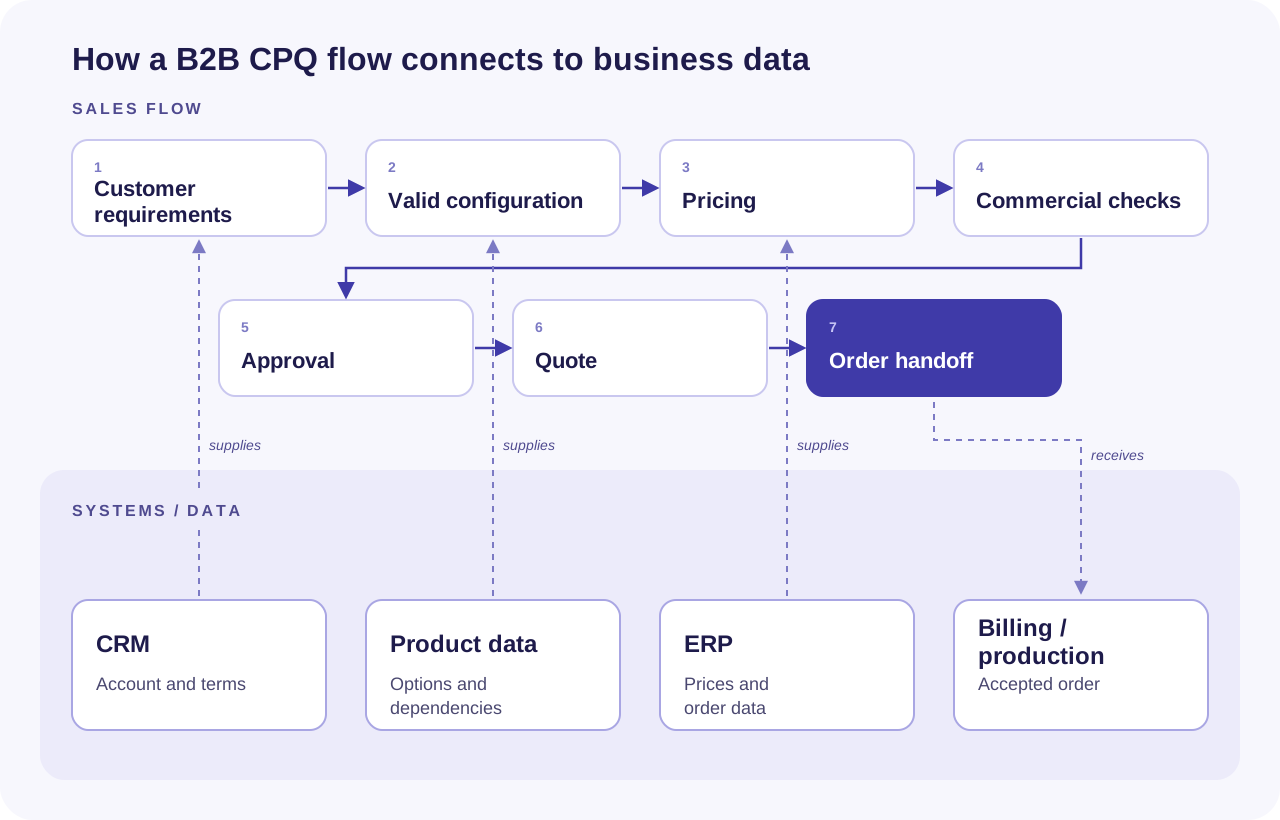
The best workflow distinguishes an invalid choice from a permitted exception. An incompatible voltage may block configuration, while an unusually large discount may require authorization; conflating the two encourages unnecessary escalation or unsafe workarounds.
After acceptance, the handoff needs structured identifiers, quantities, selected options, and commercial terms. A PDF alone is rarely the best interface for creating an accurate order, especially when operational teams must rekey its contents.
Also define what happens when source data changes during negotiation. If a component becomes unavailable or a price list expires, the business needs a policy for existing drafts, not just new quotes; the platform should expose which offer inputs require revalidation instead of silently substituting new terms.
Which B2B Sales Processes Benefit Most From CPQ?
Rule density matters more than headcount. Ten sellers offering highly variable equipment may need stronger configuration controls than a hundred sellers quoting a small, fixed catalog.
Configurable Products and Manufacturing Sales
For manufacturers selling pumps, packaging lines, or power equipment, the offer combines physical choices with installation and service obligations. A high-output option may require a larger frame, upgraded cooling, and different commissioning work.
The best CPQ fit for these manufacturers validates dependencies and passes an agreed configuration to operations. Deep engineering requirements may additionally need calculations, drawings, or a generated bill of materials; do not assume every quoting tool provides them.
Complex Pricing and Discount Structures
Customer-specific pricing, volume tiers, contract duration, promotions, and margin floors need an explicit order of precedence. Otherwise two sellers can apply individually reasonable rules and reach different prices for equivalent deals.
Centralized software reduces that inconsistency only when ownership is clear. The best policy states which discounts combine, which replace one another, and which conditions trigger a commercial review.
Margins require a shared definition too. Decide whether freight, installation labor, warranty reserves, and currency conversion belong in the calculation, and identify the cost date used; a nominal margin floor offers little protection when sales and finance use different cost bases.
Dealer, Distributor, and Partner Sales
A partner channel introduces another boundary: not every seller should see every product, cost, or negotiated rate. The platform should support the proposed channel model without exposing confidential direct-sales conditions.
For manufacturers with regional dealers, test catalog eligibility, local currency, service coverage, and responsibility for the final offer. The best demonstration includes a restricted partner account, not just an administrator showing an unrestricted catalog.
What Capabilities Matter Most in B2B CPQ Software?
Evaluate capabilities around the decisions they protect. A feature matters when it prevents an invalid commitment, makes an exception visible, or removes avoidable re-entry without losing information.
Product Configuration and Guided Selling
A SKU selector retrieves known items; guided configuration translates requirements into eligible combinations. Asking about throughput, environment, and power supply can be more useful than expecting a seller to memorize hundreds of part numbers.
The best guidance explains why an option is unavailable and what would make it valid. Check boundary conditions, such as a capacity just above a cooling threshold, rather than testing only familiar combinations.
Required inputs need units and acceptable ranges. A capacity entered in cubic feet per minute cannot safely be treated as cubic meters per hour, and an unknown site temperature should remain an unresolved requirement rather than becoming a convenient default that lets the seller continue.
Pricing Rules and Approval Workflows
Central price lists should coexist with defined customer conditions, discount limits, and margin rules. Where supported, automatic routing can request authorization when an offer crosses a threshold; verify routing, delegation, and what happens after a material revision.
A platform must not confuse permission to edit a price with permission to approve it. The best evaluation asks whether the seller can issue the document while a required decision remains unresolved, and how that behavior matches company policy.
Include an unavailable reviewer in the test. Determine who may delegate authority, whether an exception expires, and how the seller learns that a decision is pending; a routing diagram is incomplete if an absent manager leaves the deal stalled or prompts someone to bypass the intended control.
Quote Generation and Revision Management
B2B offers change as customers adjust scope and negotiate terms. Preserve distinguishable revisions, show meaningful differences, and identify exactly which configuration and price the customer accepted.
A revised document should not silently replace the commercial record behind an accepted offer. The best revision test changes a component, recalculates its dependencies, and checks whether previous acceptance or internal authorization still applies.
Quote validity also needs a defined meaning. When a buyer accepts after the stated expiry date, the business may need fresh pricing or availability checks; retaining the old document is important, but retaining it does not necessarily make its commercial terms available indefinitely.
Business-Managed Rules
Ownership becomes a bottleneck when every price adjustment requires development work. A visual editor can help pricing and RevOps teams inspect dependencies, but ease of editing is not proof that a change is safe.
Ask who can propose changes, how representative quotes are tested, and how effective dates are handled. The best software makes routine maintenance understandable without disguising the need for technical expertise on complex integrations.
Keep a small regression set containing ordinary deals, boundary values, and previously troublesome exceptions. Record expected configurations and amounts before editing a rule, then compare the results; this creates a repeatable business test rather than relying on a maintainer remembering which unrelated products might be affected.
“A quote is useful only when the business can honor the decisions inside it.”
How Does B2B CPQ Fit Into CRM, ERP, and Quote-to-Cash?
CRM usually owns accounts, opportunities, and customer communication. CPQ manages commercial configuration and the offer; ERP, order management, or billing then receives accepted data to execute the commitment. The CPQ versus CRM guide explains that distinction in more detail.
| System | Main Role | Data Used by CPQ | Data Received From CPQ |
|---|---|---|---|
| CRM | Manage relationships and opportunities | Account, opportunity, contract context | Quote reference, value, status |
| ERP | Manage resources and orders | Item identifiers, costs, availability | Accepted order lines and terms |
| Product / catalog system | Maintain product definitions | Options, attributes, compatibility | Selected product identifiers |
| Billing or subscription management | Maintain charges and active agreements | Billing cadence, existing entitlements | Accepted charges, dates, quantities |
| Production / manufacturing system | Plan and execute production | Feasibility constraints, capacity inputs | Agreed configuration and specifications |
Data allocation depends on company architecture and the chosen vendor. Check official documentation current at purchase for any claimed native integration or API; these category relationships do not establish that a particular connection exists.
Integration planning works best when someone owns each transferred field and each failure scenario. Stable customer and product identifiers, duplicate prevention, and reconciliation matter more than a connector logo on a presentation.
For example, an order endpoint might accept a request but fail to return confirmation before the connection closes. Retrying without a stable transaction reference can create a second order; the integration design needs a way to identify the first result and safely reconcile uncertainty.
For manufacturers, distinguish commercial configuration from production engineering. A sold option set may still need an engineering release before scheduling, so a successful platform handoff should not be mistaken for manufacturing authorization.
Practical Example: From Customer Requirements to an Approved B2B Quote
Consider a hypothetical industrial compressor supplier, not a Quortix customer case. A buyer needs two 75 kW units for a hot, dusty site, plus filtration, remote monitoring, commissioning, and a two-year service package.
Assume its engineering rules require an upgraded cooling pack above 40°C and a compatible controller for monitoring. The seller enters a 45°C design temperature; configuration adds cooling and rejects the basic controller before any proposal reaches the buyer.
For this example, each compressor costs $48,000 at list, cooling adds $4,000, filtration $3,000, and monitoring with its controller $2,000. The two configured units therefore total $114,000 before discounts.
Assume the customer's contract allows 6% off equipment only, superseding a 4% two-unit tier rather than stacking with it. Equipment becomes $107,160; undiscounted commissioning of $6,000, service of $8,000, and freight of $2,500 bring the offer to $123,660, excluding tax.
The buyer requests a further $3,000 reduction and delivery within eight weeks. Under this supplier's assumed policy, that discretionary concession needs sales-manager authorization, while an operations planner must separately confirm capacity; CPQ should not invent a delivery commitment from a standard lead-time field.
- Configuration check: Both units retain cooling and the monitoring-compatible controller.
- Commercial decision: The manager authorizes the extra $3,000, producing a $120,660 offer.
- Operational decision: Planning confirms the delivery window before the revised proposal is issued.
Now suppose the buyer removes monitoring from one unit. The seller creates a new revision, recalculates the affected equipment discount, and rechecks the discretionary concession instead of editing the PDF total.
Removing $2,000 at list reduces the contract-priced equipment amount by $1,880. If the same authorized concession remains applicable, the revised total is $118,780; the supplier must confirm that assumption rather than automatically carrying authorization forward.
The accepted revision sends distinct unit configurations, service scope, freight terms, and agreed delivery information downstream. Its reference connects customer acceptance to the order, while any required engineering release remains a separate operational step.
The two units now need separate configuration identities even though they share the same base model. Otherwise monitoring could accidentally be ordered twice or omitted entirely; production needs to know which physical unit receives it, and service needs the same distinction when preparing its coverage record.
How Should B2B Teams Evaluate CPQ Software?
RevOps leaders, sales operations, and pricing teams should map their actual quote process before comparing feature lists or AI demonstrations. Bring a normal deal, a troublesome exception, and a revision that previously caused rework.
Searching for the best CPQ platform for B2B manufacturers is a starting point, not a selection method. Heavy manufacturing CPQ may prioritize engineering configuration; a lighter quoting tool may prioritize documents, dealer access, or ERP-connected pricing.
| Evaluation Area | Questions to Ask | Why It Matters |
|---|---|---|
| Product complexity | Can it resolve our actual dependencies? | Prevents impossible configurations |
| Pricing complexity | Which conditions override or combine? | Keeps comparable deals consistent |
| Approval logic | What triggers review after changes? | Controls commercial exceptions |
| Integration requirements | Who owns each field and failed transfer? | Prevents conflicting records |
| Rule ownership | Who maintains logic without development? | Determines ongoing operating effort |
| Quote revisions | Can we identify the accepted version? | Preserves the agreed commitment |
| Sales usability | Can a seller finish representative tasks? | Tests practical adoption |
| Downstream handoff | What structured information reaches orders? | Avoids operational re-entry |
| Implementation effort | What cleanup and modeling are required? | Exposes work beyond licensing |
| Testing and change management | How are changes checked and recovered? | Limits unintended effects |
The best shortlist matches product depth to operational need. Manufacturers requiring engineering calculations should test those calculations explicitly; businesses with standard products should not inherit an engineering implementation merely because it looks comprehensive.
Measure elapsed quoting time alongside correction rates, exception volume, and handoff completeness. A vendor's best demonstration may follow weeks of catalog cleanup and specialist rule authoring; include that preparation and ongoing maintenance effort in your pilot record.
Run part of the pilot with an ordinary seller using realistic permissions and no presenter guiding each click. The best usability evidence is whether that person can recognize an incomplete requirement, explain a price adjustment, and recover from an invalid selection without asking an administrator to finish the quote.
Ask for costs beyond licenses, including migration, modeling, integration support, training, and ongoing administration. A platform that needs outside help for every routine price change has a different operating cost from one your pricing team can maintain.
Agree on exit conditions before committing: required data exports, ownership of modeled rules, and access to quote records if the relationship ends. The best procurement decision accounts for maintaining and eventually replacing the system, not only for getting the first proposal out of it.
When Is CPQ Too Much for a B2B Sales Process?
CPQ may be excessive for a small standard catalog with fixed prices, rare exceptions, and almost no configuration logic. A maintained price list and a reliable document process can be the best answer until complexity genuinely increases.
Software will not settle an unresolved discount policy or repair contradictory product definitions by itself. Clarify those decisions first; otherwise the implementation embeds disagreement and creates another system that people work around.
Start narrowly when uncertainty is high: one product family, one price list, and a defined handoff. The best rollout boundary is large enough to expose real dependencies but small enough for the owners to verify every result.
Write down the trigger for reconsidering that boundary. Examples include repeated configuration errors, frequent contract exceptions, or order-entry work exceeding an agreed threshold; this gives a simpler quoting process an explicit review point without treating expansion into a larger platform as inevitable.
How Quortix Supports Complex B2B Quoting
Quortix brings configurable products, pricing rules, and quote logic into a visual workspace. Its visual rules engine page explains the approach: inspect the relationships behind an offer rather than reconstructing them from disconnected sheets. The practical question is whether your intended administrator can understand and maintain those relationships.
The AI mechanism is external agents connected over MCP, the Model Context Protocol, rather than an embedded conversational copilot. Ask which authorized inspection, simulation, or object updates are demonstrated today, and what permissions bound each action.
For manufacturers, a useful demonstration would model the compressor dependencies and commercial conditions above. Ask to inspect the visual relationships, change the temperature threshold, and compare resulting configurations against an agreed set of expected outcomes.
- Revision verification: Can the demonstration distinguish quote versions and identify the customer's accepted configuration?
- Test verification: How can a proposed rule change be checked before use, and which publication controls are actually available?
- History verification: What change history can be inspected, and does it cover the rule and quote objects your process requires?
Treat revision retention, pre-publication checks, and change history as explicit acceptance criteria, not capabilities to infer from a visual editor. Request a focused demo to establish what is available today, what needs an external control, and who would operate it.
Conclusion
B2B CPQ becomes useful when calculating an offer is too complex for spreadsheets, scattered pricing rules, and repeated manual checks. Choose for the product you sell, the commercial decisions you must control, and the information an accepted quote must carry into delivery—not for the appearance of its final document.