
Best Salesforce CPQ Alternatives: 5 Options to Consider
Compare five CPQ options for product configuration, pricing, quote creation, integrations, administration, and long-term platform fit.
Salesforce CPQ has reached end of sale, not end of life. Existing customers can continue using the managed package, add users, renew subscriptions, and receive support and critical fixes. However, new licenses are no longer sold to new customers, and there is no new feature development.
Salesforce has moved its investment to Revenue Cloud Advanced, now part of Agentforce Revenue Management. There is no forced migration deadline, so an existing customer can maintain the current installation while planning deliberately. A new buyer must instead choose the successor product or evaluate alternatives to Salesforce.
For some companies, staying in the same ecosystem is the least disruptive path. Others may benefit from a standalone, modern salesforce cpq alternative with simpler ownership. This guide compares five options across product configuration, prices, rules, proposal preparation, integrations, and ongoing administration.
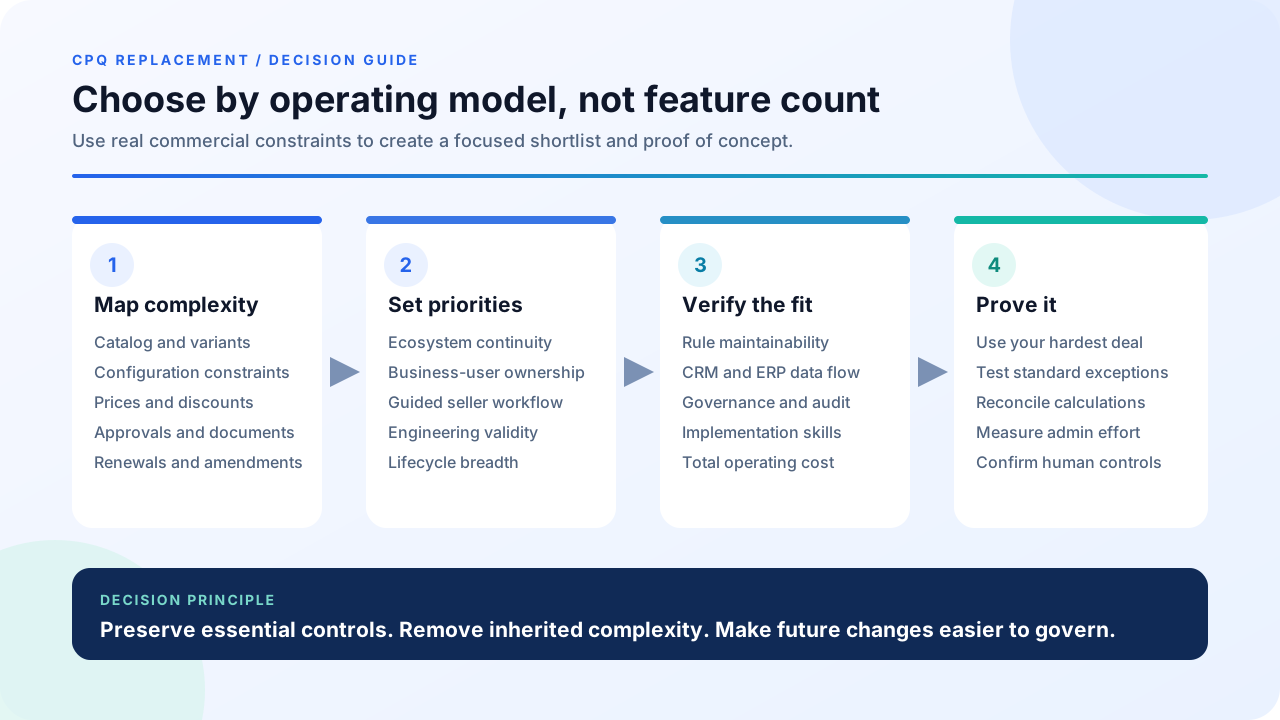
Before building a shortlist, separate urgency from direction. A stable incumbent deployment may justify a measured roadmap, especially if support coverage, performance, and current processes remain acceptable. A new implementation has a different constraint: it must select a platform available for purchase today. In either case, evaluate the alternatives against real catalog scale, pricing exceptions, approval policy, document needs, integration ownership, security review, and the people who will maintain the system after launch.
5 Best Salesforce CPQ Alternatives
The alternatives differ in more than feature lists. They represent different approaches to implementation, CRM integration, administration, and complex selling. The comparison below is a starting point for deciding which of these alternatives deserves a detailed proof of concept.
| Platform | Strongest fit | Salesforce connection | Administration profile |
|---|---|---|---|
| Quortix | Agent-assisted CPQ with governed product and pricing rules | Connect through enterprise workflows and APIs | Visual, business-user-oriented workspace |
| Revenue Cloud Advanced | Broad revenue lifecycle management | Native platform path | Enterprise platform skills and governance |
| DealHub | Guided selling and B2B quoting | CRM integration | No-code-oriented sales playbooks |
| Conga CPQ | Complex enterprise catalogs and commercial processes | Native and CRM-agnostic product options | Varies by selected Conga architecture |
| Tacton CPQ | Engineer-to-order and configurable manufacturing | CRM and enterprise-system integration | Specialized product-model expertise |
Quortix — For Governed Agent Work and Visual Administration
Quortix is designed for companies that sell complex products, apply detailed price logic, and prepare tailored offers without wanting every change to become a development project. A unified catalog holds products and variants, while a visual workspace manages configuration and pricing rules.
Authorized external agents can inspect data, simulate outcomes, and update permitted catalog, rule, or draft objects through MCP. The visual workspace lets teams inspect product and pricing relationships. Published rules remain deterministic, so the same published inputs produce a predictable commercial result.
Quortix AI is not an in-app chatbot or copilot. Authorized external AI agents connect over the Model Context Protocol (MCP) to inspect data, simulate outcomes, update permitted catalog, rule, or draft objects, and prepare a draft offer from customer requirements. The visual workspace makes that work available for inspection; buyers should establish their own review requirements for consequential changes and customer delivery.
- Inspect and simulate: examine product and pricing relationships and test outcomes.
- Use permitted agent actions: external agents can inspect data and update allowed catalog, rule, and draft objects through MCP.
- Set buyer controls: define review practices while published commercial logic stays deterministic.
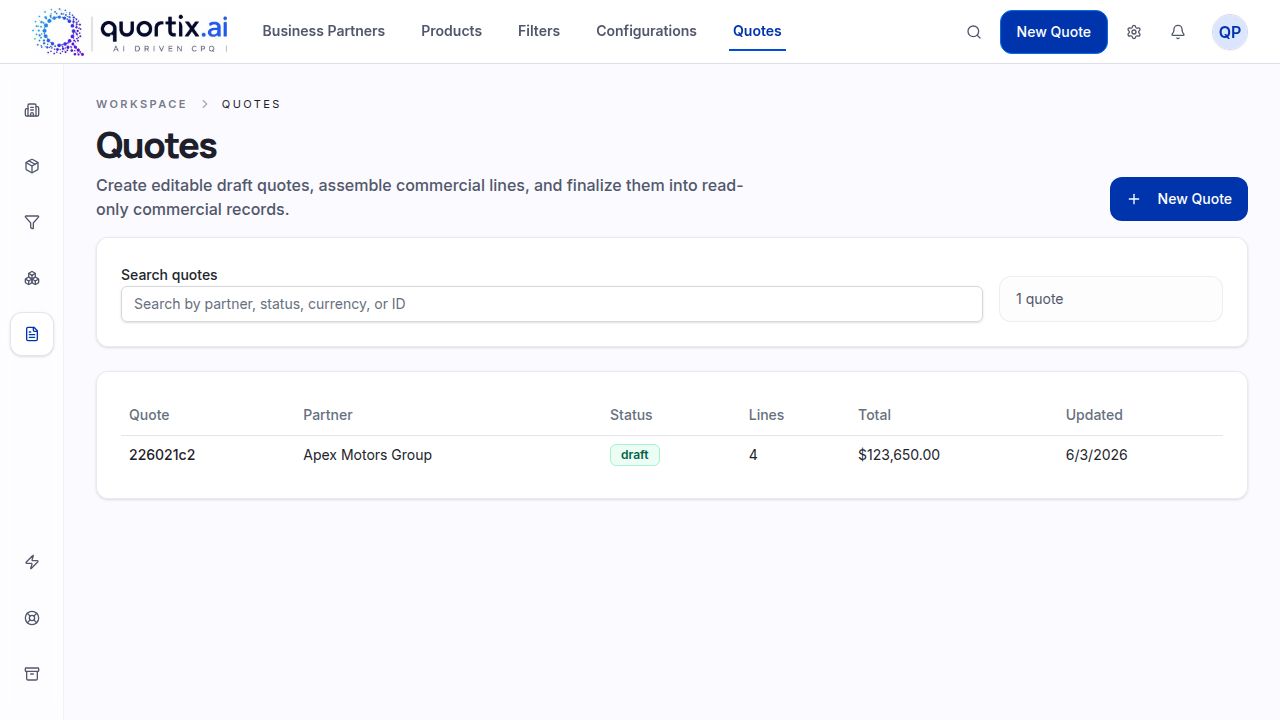
This approach is relevant when the main complaint about a legacy quoting tool is the specialist effort required to maintain it. During evaluation, ask the intended business owner to change a permitted object, test an affected configuration, and apply the company's review practice before delivery. That exercise is more informative than a prepared demonstration; implementation scope and timing still depend on catalog, integration, and migration requirements.
Revenue Cloud Advanced — For Staying in the Salesforce Ecosystem
Revenue Cloud Advanced is the official strategic path for organizations that want to remain on Salesforce. It extends beyond configuration and quoting into product catalogs, contracts, orders, assets, amendments, renewals, and other revenue-lifecycle processes.
Its primary advantage is platform continuity. Customer, opportunity, and revenue work can remain closely connected to existing Salesforce identity, automation, data, and reporting infrastructure. That can be compelling when the company already has strong platform governance and a team able to support the broader architecture.
It should not be treated as an automatic in-place upgrade. The newer data model and capabilities require process design, migration planning, and testing. Compare the complete implementation and operating model rather than assuming that ecosystem continuity means zero change.
DealHub — For Guided Selling and B2B Quoting
DealHub centers the seller experience on guided selling. A playbook asks structured questions and uses the answers to recommend the relevant products, terms, and next steps. Pricing controls and document generation then help the rep assemble a consistent customer offer.
The product integrates with Salesforce CRM, allowing deal context and commercial documents to remain connected. It is a candidate when reps need more guidance through repeatable B2B quoting and operations wants to configure sales playbooks without building a deeply customized interface. Verify which opportunity, contact, product, and quote fields move in each direction rather than treating “integration” as a yes-or-no feature.
During evaluation, test exception handling as carefully as the standard path. Guided questions are valuable only if unusual bundles, approval thresholds, and contract terms can be represented without sending the seller back to spreadsheets.
Conga CPQ — For Complex Enterprise CPQ Requirements
Conga serves organizations with large catalogs, sophisticated configurations, layered price rules, and enterprise approval processes. Its CPQ products cover guided configuration, pricing, rule management, and proposal generation, with connections to customer and contract workflows.
The vendor offers more than one CPQ route, including products oriented to Salesforce and CRM-agnostic deployments. Therefore, a fair comparison must name the specific Conga product, deployment model, and surrounding contract architecture rather than treating “Conga CPQ” as one uniform package.
Conga belongs on an enterprise shortlist when commercial complexity is genuinely high and quote-to-contract coordination matters. In a proof of concept, include a configuration amendment and contract handoff, then have the future administrator make a rule change. That exposes the skills needed for initial modeling, upgrades, and ongoing ownership.
Tacton CPQ — For Complex Manufacturing Configuration
Tacton is a more specialized option for manufacturers selling highly configurable products. Its core value appears when a commercial choice must also satisfy engineering constraints—for example, when dimensions, materials, capacity, and component compatibility determine whether a product can actually be built.
The platform brings configuration, price calculation, and quote creation together, and it can connect with Salesforce CRM and other enterprise systems. That helps align sales selections with downstream engineering and production data instead of discovering an invalid combination after the order.
Tacton illustrates why industry fit matters. General-purpose alternatives and a manufacturing configurator do not solve exactly the same problem. A manufacturer should test technical constraint modeling, visualization needs, bills of material, and handoff to ERP alongside the seller workflow.
“A successful CPQ replacement should preserve the rules that protect revenue and feasibility—not the accidental complexity that accumulated around them.”
How to Choose the Right Salesforce CPQ Replacement
Migration is not a simple data copy. It is a reconstruction of critical selling logic on a new platform. Preserve the integrations and controls that matter, but do not reproduce obsolete customizations simply because they exist today.
- Audit the existing setup. Record which catalogs, configuration rules, prices, discounts, approvals, templates, and custom code are actively used.
- Decide what to keep, rebuild, or remove. Preserve necessary controls, simplify logic that has become hard to explain, and retire unused behavior.
- Recreate product and pricing logic. Model dependencies, calculations, discount authority, bundles, and constraints in the new engine.
- Set up integrations and migrate required data. Restore CRM, ERP, finance, and identity flows; move only needed products, prices, active offers, and related records.
Testing should use sanitized versions of real sales scenarios, not an idealized demo catalog. Include an ordinary renewal, an unusual configuration, a nonstandard discount, an approval escalation, an amended order, and the final document. At each integration boundary, reconcile identifiers, quantities, prices, dates, and status—not only the grand total.
- Test standard and exceptional deals. Confirm configuration validity, calculations, approvals, documents, and write-back behavior.
- Train users and launch gradually. Prepare sellers and administrators, then phase the transition where business continuity permits.
- Monitor after migration. Measure turnaround time, error rates, exceptions, adoption, and the rule adjustments still required.
The goal is not merely to reproduce the old system. It is to make future ownership clearer. When comparing alternatives, ask a business administrator to complete a realistic catalog or rule change and follow it through testing, approval, publication, and quoting.
Conclusion
Reduce the shortlist by operating fit before comparing polished documents. Revenue Cloud Advanced favors ecosystem continuity; DealHub emphasizes guided selling; Conga addresses broad enterprise complexity; and Tacton specializes in manufacturing constraints. The deciding evidence should come from a difficult configuration, an exception, an administrator change, and a complete downstream handoff.
Quortix is the distinctive option when teams want authorized external AI agents to prepare visible work over MCP while deterministic published rules calculate outcomes. Buyers set any human-review requirements for consequential changes and customer delivery. Shortlist by operating model, then prove each claim with your hardest real deal. To evaluate that workflow against your requirements, contact Quortix.